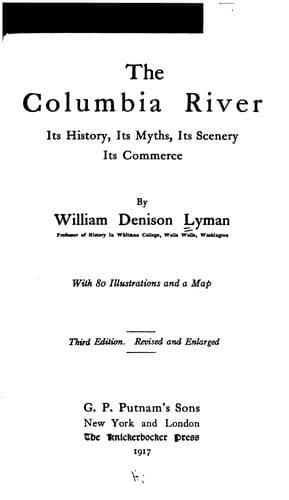
The Columbia River: Its History, Its Myths, Its Scenery, Its CommerceLyman, William Denison
History
The Columbia River: Its History, Its Myths, Its Scenery, Its Commerce
Lyman, William Denison
Columbia River; Columbia River -- Description and travel; Columbia River -- History
But before anything had actually been accomplished in the way of
exploration, that vast and important event, the Louisiana Purchase, had
been effected. The significance of this event was but little understood at
the time, even by statesmen, but Jefferson realised that a great thing
had been accomplished towards the development of the nation. His
enthusiasm and hopefulness spread to Congress and to the leaders of
opinion throughout the land. A like enthusiasm soon possessed the mass of
population, and emigration westward began. Already the older West was
teeming with that race of pioneers which has made up the life and the
grandeur of the nineteenth century. The American hive began to swarm. "Out
West" began to mean something more than Ohio and Kentucky. The distant
sources of the Missouri and the heights of the Shining Mountains, with all
the fantastic tales that had been told of them, were drawing our
grandfathers farther and farther from the old colonial America of the
eastern coast, and were beginning to modify the whole course of American
history. The atmosphere of boundless expectation gathered over farm and
town in the older States and the proposed expedition of Lewis and Clark
fascinated the people as much as the voyage of Columbus fascinated the
Spain of his day.
And what manner of men were in charge of this expedition, thus filled with
both interest and peril? Meriwether Lewis was the leader of the party. He
was a captain in the U. S. Army who was well known to Jefferson and who
had been selected by him as possessed of the endurance, boldness, and
energy which made him the fittest man within Jefferson's knowledge for the
duties of commander. His whole life, from his boyhood days in Virginia,
had been one of bold adventure. It is related that at the tender age of
eight, he was already illustrious for successful midnight forays upon the
coon and possum. He had not received a scientific education, but
immediately upon receiving the appointment of commander of the expedition,
he entered with great energy upon the acquisition of knowledge along
geographical lines which would best fit him for preserving an accurate
record of his journey. William Clark, the lieutenant of the expedition,
was also a United States officer, a man of very good judgment, boldness,
and skill in organising his work, and readiness in meeting every kind of
emergency. The party was made up of fourteen United States regular
soldiers, nine Kentucky volunteers, two French voyageurs, a hunter, an
interpreter and a negro servant. The soldiers were offered the munificent
bounty of retirement upon full pay, with a grant of land. By Jefferson's
directions, the party were encouraged to keep complete records of all they
saw and did. They carried out the instruction so fully that seven journals
besides those of Lewis and Clark themselves, were carefully kept, and in
them a record was made of every important, as well as unimportant,
Public-domain text, read in full here on John Shaqi.
Reviews
Reviews
No reviews yet
Be the first to share your thoughts on this work.
Elsewhere in the archive
Join the Discussion
Join the discussion
Sign in to leave a comment or review.
Sign InorCreate an account