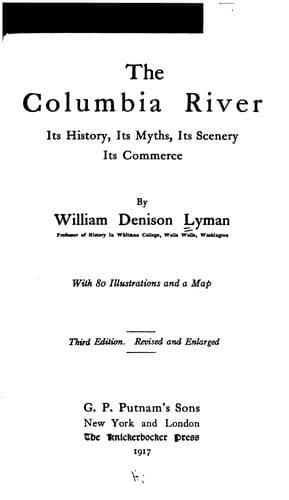
The Columbia River: Its History, Its Myths, Its Scenery, Its CommerceLyman, William Denison
History
The Columbia River: Its History, Its Myths, Its Scenery, Its Commerce
Lyman, William Denison
Columbia River; Columbia River -- Description and travel; Columbia River -- History
Captain Clark must have some bad medicine about him, for he had dropped
out of the sky with a dead crane and a duck, accompanied by a terrible
noise.
[Illustration: Mt. Hood from Lost Lake. Photo. by E. H. Moorehouse.]
The Indians being now convinced that he was a mortal man, and, moreover,
having heard the sound of the violin which the negro servant carried with
him, became so enamoured with the strangers that they stayed up with them
all night, and in the morning collected by hundreds to bid them good-bye.
The Indians had now given them to understand that in a short time they
would reach the place which they knew as "Timm." This seems to have been
an Indian word for falls. It still appears in the name Tumwater Falls
applied to the falls at Celilo on the Columbia. A weird, savage place this
proved to be; crags of basalt, thrust through the soil, like clenched
hands, seemed almost to grasp the rushing river. Making several portages,
the voyagers reached that extraordinary place now called The Dalles, or
the "big chute," where all the waters of the Columbia are squeezed into a
crack only a hundred and fifty feet in width. The River, in fact, is
"turned on edge." The explorers, finding the shore so rough that it was
difficult to carry their boats over, steered boldly through that witch's
caldron. Though they must have been carried with frightful rapidity
through the boiling stream, they reached the end of the cataract without
accident. At this point they began to be aware of the fact that they were
reaching the sphere of the white traders from the ocean, for they began to
see blankets, axes, brass kettles, and other articles of civilised
manufacture. The Indians, too, were more saucy, suspicious, and
treacherous than those of the upper country.
Being launched upon the calm, deep flood of the River below The Dalles,
they observed the phenomenon of the submerged forest, which at a low state
of water is still conspicuous. They correctly inferred that this indicated
a damming up of the River at some recent time. They thought indeed that it
could not have been more than twenty years previous. We know, however,
that submerged trees or piles, as indicated by remains of old Roman
wharves in Britain, may remain intact for hundreds of years. This place on
the Columbia is, however, one of the most interesting of its many
interesting phenomena. It is evident that within very recent times,
geologically speaking, there was a prodigious rock-slide from the
mountains which closed the River, producing the cataract of the Cascades
and raising the River above, some forty feet.
Public-domain text, read in full here on John Shaqi.
Reviews
Reviews
No reviews yet
Be the first to share your thoughts on this work.
Elsewhere in the archive
Join the Discussion
Join the discussion
Sign in to leave a comment or review.
Sign InorCreate an account