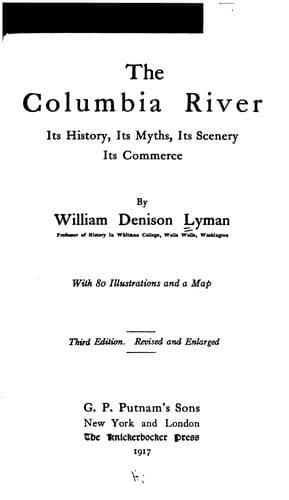
The Columbia River: Its History, Its Myths, Its Scenery, Its CommerceLyman, William Denison
History
The Columbia River: Its History, Its Myths, Its Scenery, Its Commerce
Lyman, William Denison
Columbia River; Columbia River -- Description and travel; Columbia River -- History
Here the explorers had their last portage. On the second day of November
they reached the foot of the Cascades and perceived the movement of the
tide, which made it plain to them that the ocean was near at hand. Yet, in
reality, it was much farther than they thought, for the majestic lower
River extends one hundred and sixty miles from the foot of the last
cataract to the Pacific. It is interesting to notice comments made by the
explorers upon the green and fertile islands at the lower end of the
Cascades, and that spired and turreted volcanic cliff which they called
Beacon Rock, but which we know now as Castle Rock.
The rest of the journey of Lewis and Clark was a calm floating down the
tranquil flood of the lower Columbia in the midst of the fog and clouds
which at that season of the year generally embrace all objects. On
November 7th the mist suddenly broke away before them, the bold
mountainous shores vanished in front, and, through the parted headlands,
they looked forth into the expanse of the ocean.
[Illustration: Eliot Glacier, Mt. Hood. Photo. by E. H. Moorehouse.]
Their journey was now ended. They had demonstrated the possibility of
crossing the continent and of linking together the waters of the Missouri
and the Columbia.
The winter of 1805-06 was spent in log buildings at a point named by the
explorers, Fort Clatsop, situated on the Lewis and Clark River at the
south side of the Columbia a few miles from the present site of Astoria.
The location of this fort has been identified in modern times, as has also
the location of the salt cairn, upon what is now known as the Seaside
Beach, commemorated by an inscription.
One of the interesting little human touches in the narrative of Captain
Lewis describes the casting of a whale upon Clatsop Beach and the journey
of the party to see the great marine curiosity, as well as to secure some
of its fat and blubber. The Indian woman, Sacajawea, was to be left behind
to keep camp while they were all at the beach, but she put up the earnest
plea that inasmuch as she had never seen any such curiosity as the "big
fish," and as she had journeyed all those weary miles from the country of
the Mandans, it seemed hard that she should be denied the privilege of
satisfying her eyes with a view of the whale. Lewis remarks that the
request of the poor woman seemed so reasonable that they at once fixed up
camp in such manner that it could be left, and took her with them, to her
intense satisfaction.
After four months spent in the fogs and mists of the coast, and without
seeing any of the ships which the Indians said were accustomed to come in
considerable numbers during the spring and summer, the party turned their
faces homeward on the 23d of March, 1806. The commander posted upon the
fort a notice which read as follows:
Public-domain text, read in full here on John Shaqi.
Reviews
Reviews
No reviews yet
Be the first to share your thoughts on this work.
Elsewhere in the archive
Join the Discussion
Join the discussion
Sign in to leave a comment or review.
Sign InorCreate an account