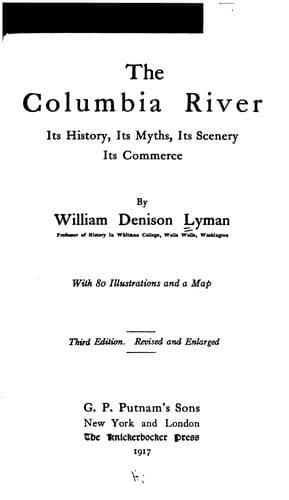
The Columbia River: Its History, Its Myths, Its Scenery, Its CommerceLyman, William Denison
History
The Columbia River: Its History, Its Myths, Its Scenery, Its Commerce
Lyman, William Denison
Columbia River; Columbia River -- Description and travel; Columbia River -- History
The object of this last is that through the medium of some civilised
person who may see the same, it may be made known to the world that
the party consisting of the persons whose names are hereunto annexed
and who were sent out by the Government of the United States to
explore the interior of the continent of North America, did penetrate
the same by way of the Missouri and Columbia Rivers, to the discharge
of the latter into the Pacific Ocean, at which they arrived on the
14th day of November, 1805, and departed on their return to the United
States by the same route by which they had come.
They also gave to the chiefs of the Clatsops and Chinooks certificates, to
which they attached great importance and which were afterwards exhibited
to other explorers, setting forth the just and hospitable treatment which
these Indians had accorded the party.
The return from Fort Clatsop to the Missouri was in the main a pleasant
and successful journey without extraordinary event, except the fact that
upon their return they discovered the Willamette River, which, strange to
say, had eluded their observation on their journey down the River in
November. The journal contains the somewhat quaint statement that the
chief cultivable region which they discovered in Oregon was Wapatoo
Island, now known as Sauvie's Island, at the mouth of the Willamette. They
express the conviction that that fertile tract of country and the region
adjoining might sometime support a population of fifty thousand people.
They seem to regard this as an extraordinary prophecy of prosperity.
Inasmuch as there are already over four times that number of people in the
city of Portland, it would seem that Lewis and Clark were hardly "boomers"
in the modern sense of the word.
One interesting thing in connection with the Lewis and Clark expedition
receives special emphasis from them in the account of their return
journey, and that is, the faithfulness, honesty, and devotion of the
Indians when entrusted with any charge, as the care of horses or canoes.
This character of the Indians was so marked that one can hardly avoid the
conclusion that the subsequent troubles with the Indians were due very
largely to abuse by the whites.
No better summary can be given of the scope of this historic journey than
that by Captain Lewis himself in his journal. He says:
Public-domain text, read in full here on John Shaqi.
Reviews
Reviews
No reviews yet
Be the first to share your thoughts on this work.
Elsewhere in the archive
Join the Discussion
Join the discussion
Sign in to leave a comment or review.
Sign InorCreate an account