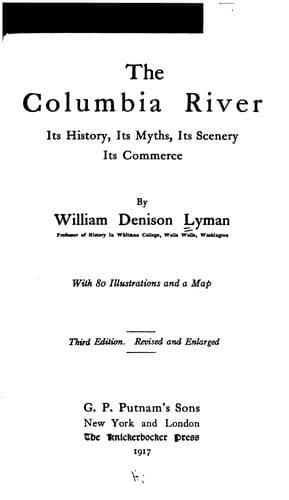
The Columbia River: Its History, Its Myths, Its Scenery, Its CommerceLyman, William Denison
History
The Columbia River: Its History, Its Myths, Its Scenery, Its Commerce
Lyman, William Denison
Columbia River; Columbia River -- Description and travel; Columbia River -- History
Of the many remarkable explorations which followed, with all of their
adventure and tragedy, we cannot here speak. For several years all the
expeditions to the far West were the outgrowth of the fur-trade. Most
remarkable of these early journeys was that of the Hunt party which was
the land division of the great Astor movement to establish the Pacific Fur
Company. That company was established by John Jacob Astor of New York for
the purpose of making a bold and far-reaching attempt to control the
fur-trade of the Pacific Coast in the interests of the United States.
While the sea division was upon its journey around Cape Horn, the land
division was in process of organisation at St. Louis. Wilson Price Hunt,
the commander of this division, was the second partner in the Astor
company. He had been merchandising for some years at St. Louis, and had
become impressed with the financial profits of the fur-trade as well as
with the vast possibilities of American development on the continent. Hunt
was a fine type of the pioneer promoter of that age. Brave, humane,
cheerful, and resolute, he appears to us as the very flower of the
adventurous Argonauts who were searching for the seal and beaver fleeces
of the far West.
With Hunt were associated four other partners of the expedition, Crooks,
McKenzie, Miller, and McCellan. Accompanying the party were two English
naturalists, Bradbury and Nuttall, who did the first scientific study of
the Rocky Mountain region. There were forty Canadian _voyageurs_ whose
duties consisted of rowing, transporting, cooking, and general drudgery.
The remaining twelve of the party consisted of a group of American hunters
and trappers, the leader of whom was a Virginian named John Day. The
company was in all respects fitted out most bountifully.
There were at that time two great classes of trappers. The first and most
numerous were the Canadian _voyageurs_. These were mainly of French
descent, many of them being half-breeds. Almost amphibious by nature and
training, gay and amiable in disposition, with true French vivacity and
ingenuity, gliding over every harsh experience with laugh and song,
possessed of quick sympathies and humane instincts which enabled them to
readily find the best side of the Indians,--these French _voyageurs_
constituted a most interesting as well as indispensable class in the
trapper's business.
Public-domain text, read in full here on John Shaqi.
Reviews
Reviews
No reviews yet
Be the first to share your thoughts on this work.
Elsewhere in the archive
Join the Discussion
Join the discussion
Sign in to leave a comment or review.
Sign InorCreate an account