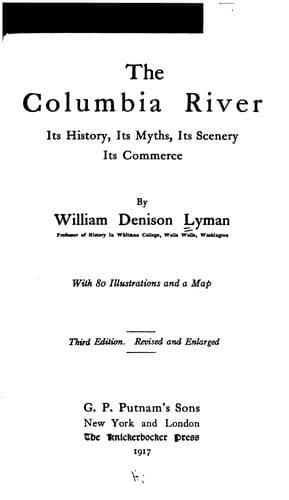
The Columbia River: Its History, Its Myths, Its Scenery, Its CommerceLyman, William Denison
History
The Columbia River: Its History, Its Myths, Its Scenery, Its Commerce
Lyman, William Denison
Columbia River; Columbia River -- Description and travel; Columbia River -- History
The free trappers were an entirely different class of men. They were
usually American by birth, Virginia and Kentucky being the homes of most
of them. Patient and indefatigable in their work of trapping, yet, when on
their annual trip to the towns, given to wild dissipation and savage
revellings, indifferent to sympathy or company, harsh and cruel to the
Indians, bold and overbearing, with blood always in their eyes, thunder in
their voices, and guns in their hands, yet underneath all of their harsh
exterior having noble hearts, could they but be reached, these now
vanished trappers have gone to a place in history alongside of the old
Spartans and the followers of Pizarro and Cortez in Spanish conquest.
Of the many adventures of the Hunt party on the journey up the Missouri,
we cannot speak. For some reason, although taking a more direct route than
did Lewis and Clark, and having, to all appearance, a better equipped
party, they did not make so good time. Guided by Indians, they crossed
chain after chain of mountains, supposing each to be the summit, only to
find another yet to succeed. At last on the 15th of September, they stood
upon a lofty eminence over which they could gaze both eastward and
westward. Scanning attentively the western horizon, the guide pointed out
three shining peaks, whose bases, he told them, were touched by a
tributary of the Columbia River. These peaks are now known as the Three
Tetons.
And now the party set forth upon the long descent of the western slope,
passing mountain after mountain and stream after stream, some of the way
in boats which the _voyageurs_ made from the green timber of the forests,
and much of the way being obliged to carry their effects around cataracts
and rapids, and thus losing much time. Nevertheless, they found one long
stretch of over a hundred miles upon the upper Snake which they navigated
with comparative ease. But having reached what is now known as the Seven
Devils country in South-western Idaho, they found themselves in a chain of
rapids and precipitous bluffs where neither boats nor horses, apparently
nothing but wings, could be of service. This was in fact the beginning of
over a hundred miles of the most ragged and inaccessible region upon the
whole course of the Snake River, a region which even to this day contains
neither road nor steamboat route, and by which the great State of Idaho is
separated into two divisions, neither directly accessible to the other by
any ordinary modes of travel.
After a forty-mile tramp up and down the river, Hunt decided that the only
way to escape the difficulties with which they were surrounded, was to
divide the party into four divisions, hoping that one of them might find
game and a way out of the forbidding volcanic wastes in which they were
beleaguered. Two of the parties soon returned. One, being in charge of
McKenzie, continued upon its course northward and reached the mouth of the
Columbia, without ever again seeing the main party.
Public-domain text, read in full here on John Shaqi.
Reviews
Reviews
No reviews yet
Be the first to share your thoughts on this work.
Elsewhere in the archive
Join the Discussion
Join the discussion
Sign in to leave a comment or review.
Sign InorCreate an account