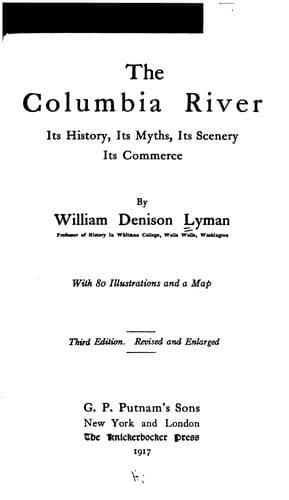
The Columbia River: Its History, Its Myths, Its Scenery, Its CommerceLyman, William Denison
History
The Columbia River: Its History, Its Myths, Its Scenery, Its Commerce
Lyman, William Denison
Columbia River; Columbia River -- Description and travel; Columbia River -- History
Without doubt one of the earliest uses to which man has put the lower
animals is that of clothing his body in their captured skins. The
acquisition of furs has been a special feature of the colder climes. It is
obviously also a feature of discovery and conquest, for it is the
wilderness only which yields any considerable number of fur-producing
animals. Thus navigation, commerce, discovery, invention, economics,
finally international wars and policies, have been rooted to a large
degree in this primal business. The fur-hunters have held the hunters of
gold and precious stones and spicery a close race in the rank of world
movers. Indeed it may well be questioned whether results of greater moment
to humanity have not proceeded from the quest for furs than from that for
gold.
The Spaniards expended their energies in the gold and silver hunt in
Mexico and Peru and annihilated the races of those lands in their pitiless
rapacity. The other great exploring nations of the sixteenth century,
especially the French, while not indifferent to the possibility of
encountering the precious metals, found more certain and permanent results
in the less feverish and dazzling pursuit of the wild animals of the
wilderness. Neither the hunters for gold nor those for peltries were the
state-builders and home-builders without whom our American Union would not
exist. But they were the avant-couriers of both. Our land of Oregon has
had the peculiar fortune of being opened by both for both.
China furnished the most active and convenient market for furs to those
who secured their supplies on the Pacific Coast of North America. The
Russians were the first Europeans to enter the Chinese market, and they
began their voyages as early as 1741.
The sea-otter seems to have had its chief habitat on the Pacific shore
from Oregon to Alaska, and, as the ships of all nations began to crowd
upon the location of the fabled Strait of Anian, the trade with the
natives for these precious furs became constantly augmented, until the
curious and interesting creatures, so fatally attractive, were added to
the long list of "lower creatures" whom the greed of the "higher
creatures" has exterminated. A book by Coxe published in London in 1787
first made known to the English-speaking people the rich profits of the
Russians from the transportation of the sea-otter skins to China. He
instanced a case of a profit of $50,000 from a single cargo. It had,
however, been known in 1785 from the report of the voyage of Captain Cook
that the North-west Coast of America contained a new source of wealth from
the accumulation of these furs by the Indians and their eager desire to
trade them for trinkets and implements of civilised manufacture.
Public-domain text, read in full here on John Shaqi.
Reviews
Reviews
No reviews yet
Be the first to share your thoughts on this work.
Elsewhere in the archive
Join the Discussion
Join the discussion
Sign in to leave a comment or review.
Sign InorCreate an account