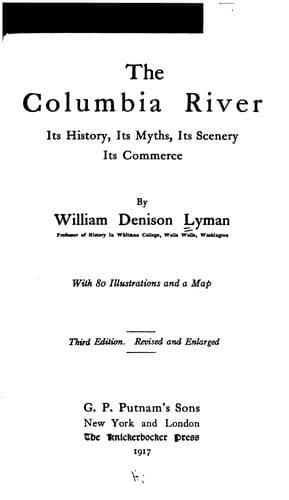
The Columbia River: Its History, Its Myths, Its Scenery, Its CommerceLyman, William Denison
History
The Columbia River: Its History, Its Myths, Its Scenery, Its Commerce
Lyman, William Denison
Columbia River; Columbia River -- Description and travel; Columbia River -- History
The first American to comprehend the greatness of the fur-trade on the
North-west Coast of the Pacific, both as a means of profit to himself and
as a patriotic impulse to direct his own nation into the channels of
westward expansion, was John Ledyard. Thomas Jefferson and John Paul Jones
became deeply interested in Ledyard's extravagant hopes of future wealth
and glory, but all his efforts came to naught, and in 1788 this brilliant
adventurer, just on the eve of setting out to explore the interior of
Africa, suddenly put an end to his own life at Cairo, Egypt. Ledyard
should always be remembered by his countrymen, for, though his glowing
visions were unfulfilled, he was an important link in the great chain
which bound Oregon to our own country.
During these same years, several Englishmen, already noted in the chapter
on discovery, Portlock, Dixon, Hanna, Barclay, and Meares, were actively
engaged in the fur-trade, while the voyages of La Perouse and Marchand
carried the flag of France on the same quest, and Spain's once illustrious
emblem of world dominion was borne by Quadra, Valdes, Galiano, Fidalgo,
Quimper, Caamano, and several others. While these explorers all were
impelled in part by national pride and diplomacy, the hope of sharing the
spoils of the sea-otter droves was the chief lure to the tempestuous seas
of the North Pacific.
In Bullfinch's _Oregon and El Dorado_ is a very interesting narration of
the inception of the American part in the fur-trade of Oregon. In a
building known as the Coolidge Building in Boston a company were gathered
together in 1787 discussing the reports, then first made public, of Cook's
voyages. Mr. Joseph Barrell, a rich merchant of Boston, was much impressed
with Cook's account of the chances of barter with the Indians for furs and
the disposal of them in China for yet more profitable cargoes of teas,
silks, and other characteristic commodities of that land. As a result of
this conference, a company was formed in Boston to prosecute such
enterprise, the members of the company, Messrs. Barrell, Brown, Bulfinch,
Darby, Hatch, and Pintard, being among the foremost of the business men in
Boston in that good year of the creation of the American Constitution.
Public-domain text, read in full here on John Shaqi.
Reviews
Reviews
No reviews yet
Be the first to share your thoughts on this work.
Elsewhere in the archive
Join the Discussion
Join the discussion
Sign in to leave a comment or review.
Sign InorCreate an account