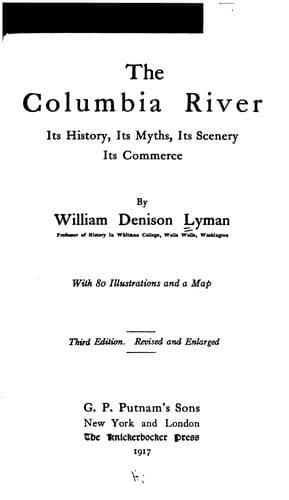
The Columbia River: Its History, Its Myths, Its Scenery, Its CommerceLyman, William Denison
History
The Columbia River: Its History, Its Myths, Its Scenery, Its Commerce
Lyman, William Denison
Columbia River; Columbia River -- Description and travel; Columbia River -- History
The field of operations was gradually extended from the south-eastern
regions contiguous to Hudson's Bay until it embraced the vast and dreary
expanses of snowy prairie traversed by the Saskatchewan, the Athabasca,
the Peace, and finally the Mackenzie. Many of the greatest expeditions by
land under British auspices which resulted in great geographical
discoveries were primarily designed for the expansion of the fur-trade.
Just at the critical moment, both for the great Canadian Fur Company, as
well as for discovery and acquisition in the region of the Columbia, a
most important and remarkable champion entered the lists. This was the
North-west Fur Company of Montreal. It was one of the legitimate
consequences of the treaty of Paris in 1763, ceding Canada to Great
Britain. The French in Canada became British subjects by that treaty, and
many of them had extensive interests as well as experience in the fur
business. Furthermore a number of Scotchmen of great enterprise and
intelligence betook themselves to Canada, eager to partake of the
boundless opportunities offered by the new shuffle of the cards. These
Scotchmen and Frenchmen became natural partners in the foundation of
enterprises independent of the Hudson's Bay monopoly. In 1783 a group of
the boldest and most energetic of these active spirits, of whom the
leaders were McGillivray, McTavish, Benjamin and Joseph Frobisher,
Rechebleve, Thain, and Frazer, united in the formation of the North-west
Fur Company. Bitter rivalry soon arose between the new company and the old
monopoly. Following the usual history of special privilege, the old
company, which had now been in existence one hundred and thirteen years,
had learned to depend more on privilege than on enterprise, and had become
somewhat degenerate. The North-westers "rustled" for new business in new
regions. In 1789 Alexander Mackenzie, as one of the North-westers, made
his way, with incredible hardship, down the river which bears his name to
the Frozen Ocean. A few years later he made the first journey to the shore
of the Pacific, commemorating his course by painting on a rock on the
shore of the Cascade Inlet, north-east of Vancouver Island, these words:
"Alexander Mackenzie, from Canada, by land, the twenty-second of July, one
thousand seven hundred and ninety-three."
Public-domain text, read in full here on John Shaqi.
Reviews
Reviews
No reviews yet
Be the first to share your thoughts on this work.
Elsewhere in the archive
Join the Discussion
Join the discussion
Sign in to leave a comment or review.
Sign InorCreate an account