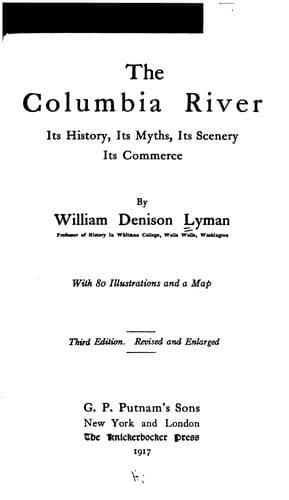
The Columbia River: Its History, Its Myths, Its Scenery, Its CommerceLyman, William Denison
History
The Columbia River: Its History, Its Myths, Its Scenery, Its Commerce
Lyman, William Denison
Columbia River; Columbia River -- Description and travel; Columbia River -- History
As a result of the new undertakings set on foot by the North-westers and
the reawakened Hudson's Bay Company, both companies entered the Columbia
Valley. The struggle for possession of Oregon between the English and
American fur companies and their government was on. In the summer of 1810
David Thompson of the North-west company crossed the continental divide by
the Athabasca Pass in latitude 52 deg. 25'. The North-westers had heard of the
Astor enterprise in New York and realised that they must be up and doing
if they would control the land of the Oregon. Although the character of
soil, climate, and productions of the Columbia Valley was but imperfectly
known, enough had been derived from Lewis and Clark, and from ocean
discoveries to make it plain that the Columbia furnished the most
convenient access to the interior from the sea, and that its numerous
tributaries furnished a network of boatable waters unequalled on the
Western slope, while there was every reason to suppose that its forests
abounded in fur-bearing animals and that its climate would admit of much
longer seasons of work than was possible in the biting winters of the
Athabasca. It became vital to the continental magnitude of the designs of
the Canadian companies that they control Oregon.
For greater topical clearness we will anticipate a little at this point
and state that after several years of intense rivalry it became plain to
the British Parliament that it was suicidal to allow a policy of division
in the face of a common enemy. Hence in 1821, by act of Parliament, the
two companies were reorganised and united under a charter which was to
last twenty-one years (and as a matter of fact was renewed at the end of
that time), and under the provisions of which the North-westers were to
have equal shares in both stock and offices, though the name of the
Hudson's Bay Company, was retained. It will be remembered therefore, that
up to the year 1821, the two great Canadian companies were distinct, and
that during that time the North-west Company was much the more active and
aggressive in the Columbia Valley, but that after that date the entire
force of the Canadian Companies was combined under the name of the old
monopoly. But however bitter the first enmity of the Canadian rivals, they
agreed on the general proposition that the Americans must be checkmated,
and during the score of years prior to their coalition they were seizing
the pivotal points of the Oregon country. During the next two decades
they created a vast network of forts and stations, and reduced the country
contiguous to the River and its tributaries to a system so elaborate and
interesting as to be worthy of extended study. We can sketch only its more
general features. And the more perfectly to understand them, we must
arrest here the story of the great Canadian monopoly and bring up the
movement of the American fur companies.
Public-domain text, read in full here on John Shaqi.
Reviews
Reviews
No reviews yet
Be the first to share your thoughts on this work.
Elsewhere in the archive
Join the Discussion
Join the discussion
Sign in to leave a comment or review.
Sign InorCreate an account