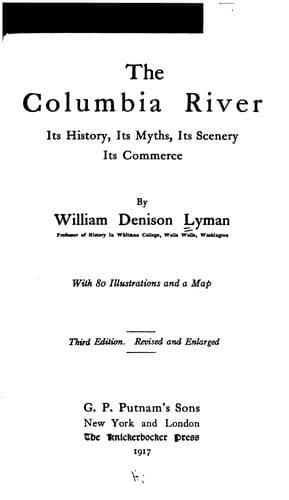
The Columbia River: Its History, Its Myths, Its Scenery, Its CommerceLyman, William Denison
History
The Columbia River: Its History, Its Myths, Its Scenery, Its Commerce
Lyman, William Denison
Columbia River; Columbia River -- Description and travel; Columbia River -- History
Setting sail with a crew of twenty-two men and an excellent supply of
stores and ammunition, and abundance of tools and hardware for erecting
needful buildings, the _Albatross_ left Boston in the summer of 1809.
After a slow and tedious, but very healthful and comfortable voyage,
stopping at the Hawaiian Islands on the route, the _Albatross_ reached the
mouth of the Columbia River on May 26, 1810. Many American and other ships
had entered the mouth of the River prior to that date, but so far as known
none had ascended any considerable distance. Apparently Gray and Broughton
were the only shipmasters who had ascended above the wide expanse now
known as Gray's Bay, while the Lewis and Clark expedition contained the
only white men who had seen the river above tide-water. The Winship
enterprise may be regarded with great interest, therefore, as the first
real attempt to plant a permanent establishment on the banks of the River.
Winship and his companions spent some days in careful examination of the
river banks and as a result of their search they decided on a strip of
valley land formed by a narrowing of the River on the north and an
indentation of the mountain on the south. This pleasant strip of fertile
land is located on the south bank of the lordly stream, and its lower end
is about forty-five miles from the ocean. Being partially covered with a
beautiful grove of oak trees, the first to be seen on the ascent of the
River, the place received the name of Oak Point. It may be noted that this
name was subsequently transferred to a promontory nearly opposite on the
north bank, and this circumstance has led many to locate erroneously the
site of the first buildings designed for permanent use on the banks of
the Columbia. And such these were, for the Lewis and Clark structures at
what they called Fort Clatsop, erected four and a half years earlier, were
meant only for a winter's use. But the Winship party had glowing visions
of a great emporium of the fur-trade, another Montreal or St. Louis, to
inaugurate a new era for their country and themselves. They designed
paying the Indians for their lands and in every way treating them justly.
They seem in short to have had a very high conception of the dignity and
worth of their enterprise. They were worthy of the highest success, and
the student of to-day cannot but grieve that their high hopes were dashed
with disaster.
Public-domain text, read in full here on John Shaqi.
Reviews
Reviews
No reviews yet
Be the first to share your thoughts on this work.
Elsewhere in the archive
Join the Discussion
Join the discussion
Sign in to leave a comment or review.
Sign InorCreate an account