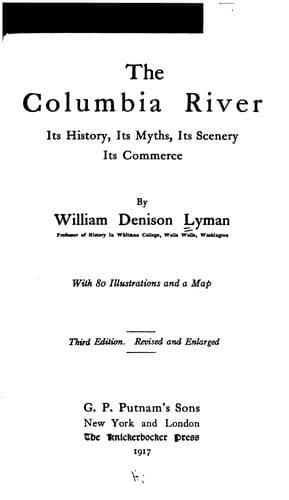
The Columbia River: Its History, Its Myths, Its Scenery, Its CommerceLyman, William Denison
History
The Columbia River: Its History, Its Myths, Its Scenery, Its Commerce
Lyman, William Denison
Columbia River; Columbia River -- Description and travel; Columbia River -- History
June 12th.--The ship dropped further down the River, and it was now
determined to abandon all attempts to force a settlement. We have
taken off the goats and hogs which were left on shore for the use of
the settlement, and thus we have to abandon the business, after
having, with great difficulty and labour, got about forty-five miles
above Cape Disappointment; and with great trouble began to clear the
land and build a house a second time, after cutting timber enough to
finish nearly one-half, and having two of our hands disabled in the
work. It is, indeed, cutting to be obliged to knuckle to those whom
you have not the least fear of, but whom, from motives of prudence,
you are obliged to treat with forbearance. What can be more
disagreeable than to sit at the table with a number of these rascally
chiefs, who while they supply their greedy mouths with your food with
one hand, their bloods boil within them to cut your throat with the
other, without the least provocation.
On the way out of the River Captain Winship learned that the Chinooks
designed capturing his vessel, and would doubtless have done so, had not
his vigilance prevented.
While the crew of the _Albatross_ were engaged in these adventures the
largest American Fur Company yet formed was getting ready to effect a
lodgment on the shores of the Columbia. This was the Pacific Fur Company.
John Jacob Astor was the founder of this enterprise. Though unfortunate in
almost every feature of its history and its final outcome, this company
had a magnificent conception, a royal grandeur of opportunity, and it
possessed also the felicity, shared by no one of its predecessors, of the
genius of a great literary star to illuminate its records. To Washington
Irving it owes much of its fame. Yet the commercial genius of Astor could
not prevent errors of judgment by the management any more than the
literary genius of Irving was able to conceal their errors, or the genius
of American liberty able to order events so as to prevent victory for a
time by the "Britishers." As we view the history in the large it may be
that we shall conclude that the British triumph at first was the best
introduction to American triumph in the end.
Public-domain text, read in full here on John Shaqi.
Reviews
Reviews
No reviews yet
Be the first to share your thoughts on this work.
Elsewhere in the archive
Join the Discussion
Join the discussion
Sign in to leave a comment or review.
Sign InorCreate an account