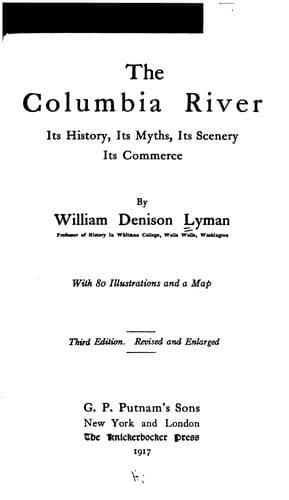
The Columbia River: Its History, Its Myths, Its Scenery, Its CommerceLyman, William Denison
History
The Columbia River: Its History, Its Myths, Its Scenery, Its Commerce
Lyman, William Denison
Columbia River; Columbia River -- Description and travel; Columbia River -- History
To cap the climax of misfortunes, the War of 1812 burst upon the knowledge
of the fur-traders and seemed to force upon such of the partners as were
of British nationality the question of their paramount duty. As a result
of the crisis, McDougal and McKenzie, although against the wishes of the
other partners present, sold out to the agent of the North-westers, who
had repaired at once to Astoria upon knowledge of the declaration of war.
Thus the great Astoria enterprise was abandoned, and the Stars and Stripes
went down and the Union Jack went up. Soon after the transfer, the British
man-of-war _Raccoon_, Captain Black, arrived at Astoria, expecting to have
seized the place as a rich prize of war. Imagine the disgust of the
expectant British mariners to discover that the post had already been sold
to British subjects, that their long journey was useless, and that their
hopes of prize money had vanished.
With the close of the War of 1812 a series of negotiations between the
ministers of the two countries took place in regard to the possession of
the River, by which it was finally decided that Astoria should be restored
to the United States. Accordingly, on the 6th of October, 1818, the
British Commissioners, Captain F. Hickey, of His Majesty's Ship _Blossom_,
and J. Keith, representing the North-west Fur Company, signed an act of
delivery restoring Fort George (Astoria) to the United States. Mr. J. B.
Prevost, Commissioner for the United States, signed the act of acceptance.
Astoria was once again American property.
[Illustration: Steamer _Beaver_, the First Steamer on the Pacific, 1836.]
[Illustration: Portland, Oregon, in 1851. From an Old Print.]
While the River was now nominally in possession of the United States, it
was practically under the control of the British fur companies. The
Pacific Fur Company ceased to operate, and the North-westers entered upon
active work both by sea and land in exploring the vast and profitable
domain which the misfortunes of their American rivals, supplemented in a
most timely manner by the treachery of McDougall and McKenzie, had put
within their power. The canny Scotchmen, McDougall, McTavish, McKenzie,
McDonald, and the various other Macs who now guided the plans of the
North-westers, signalled their entrance into power by despatching
companies to the various pivotal points of the great Columbia Basin, the
Walla Walla, Yakima, Okanogan, Spokane, and Snake rivers. Two incidents
may be related to illustrate the character of people and the conditions of
that wilderness period.
Public-domain text, read in full here on John Shaqi.
Reviews
Reviews
No reviews yet
Be the first to share your thoughts on this work.
Elsewhere in the archive
Join the Discussion
Join the discussion
Sign in to leave a comment or review.
Sign InorCreate an account