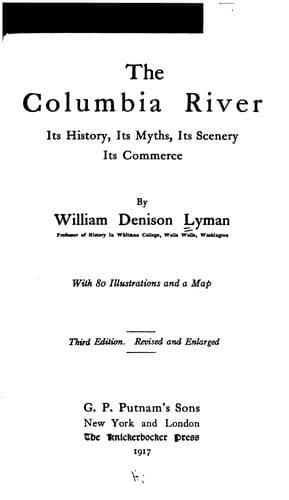
The Columbia River: Its History, Its Myths, Its Scenery, Its CommerceLyman, William Denison
History
The Columbia River: Its History, Its Myths, Its Scenery, Its Commerce
Lyman, William Denison
Columbia River; Columbia River -- Description and travel; Columbia River -- History
A party of ninety men in ten canoes left Astoria for up-river points on
April 4, 1814. While passing the mouth of the Yakima, about three hundred
and fifty miles up the River, the men were surprised to see three canoes
putting out from shore and to hear a child's voice calling out, "_Arretez
donc! arretez donc!_" Stopping to investigate, the party found in one of
the boats the Indian wife of Pierre Dorion, with her children. Dorion,
with five other Canadians, had gone the previous summer with a party under
command of John Reed of the Astor Company. While trapping and hunting,
deep in the mountains of Snake River, the party had been massacred by
Indians. The woman and her two boys had alone escaped the massacre. It was
the dead of winter and the snows lay deep on the Blue Mountains. But the
wife of Dorion found shelter in a remote fastness of the mountains,
putting up a bark hut for a shelter and subsisting on the carcasses of
some of her horses. In the spring, the pitiful little company of mother
and children descended to Walla Walla and found there more kindly disposed
natives, who cared for them and turned them over to the protection of the
whites. A more thrilling story of suffering and heroism than this of
Madame Dorion and her children has never come up from the chronicles of
the wild West.
Equally illustrative of the life of the fur-traders is the account given
by Alexander Ross of one of his many adventures in the Columbia country.
In 1814 Ross went from Okanogan to Yakima to secure horses. With him were
four other whites and three Indian women. The Yakima Valley was then as
now a paradise of the Indians. There the tribes gathered by the thousands
in the spring to dig camas, to race horses, and to gamble, as well as to
form alliances and make plans for war. When the little company of traders
reached the encampment, they discovered to their astonishment that it was
a veritable city. Six thousand men, women, and children, with ten thousand
horses, and uncounted dogs and many shackled bears and wolves, were strewn
across the plain. It was a dangerous situation for the traders, for it
became plain to them that the Indians were unfriendly. But assuming an air
of careless bravado, Ross proceeded to display his store of trinkets for
the purpose of starting a traffic in horses. Assuming a very hilarious
manner the Indians would seize and drive away the animals as fast as the
white men got them. Then the Indians began to deprive them of clothes and
food. Finally they made ready to seize their three women as slaves. Ross
managed to have the women escape temporarily, but then the savages were
worse than ever. Matters reached a crisis when an obstreperous chief named
Yaktana snatched a knife from the hands of one of the Canadians. A
desperate struggle was just at the point of breaking out, which would
inevitably have resulted in the death of all the white men, when a sudden
intuition flashed through the quick mind of Ross, and rushing between the
Public-domain text, read in full here on John Shaqi.
Reviews
Reviews
No reviews yet
Be the first to share your thoughts on this work.
Elsewhere in the archive
Join the Discussion
Join the discussion
Sign in to leave a comment or review.
Sign InorCreate an account