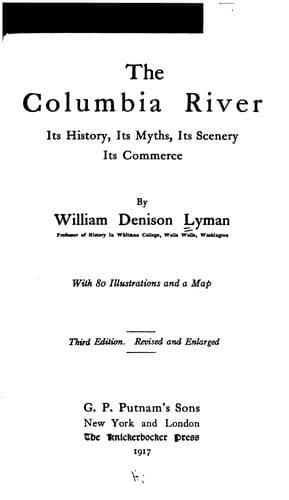
The Columbia River: Its History, Its Myths, Its Scenery, Its CommerceLyman, William Denison
History
The Columbia River: Its History, Its Myths, Its Scenery, Its Commerce
Lyman, William Denison
Columbia River; Columbia River -- Description and travel; Columbia River -- History
In the _Illinois Patriot_ of October, 1833, the same topic was taken up,
together with the statement that Walker's report had excited so much
interest that a committee of the Illinois Synod had been appointed to
investigate and report on what seemed the duty of the churches in the
premises. The committee accordingly went to St. Louis and confirmed the
account by conference with General Clark. They also made it an object to
learn all available facts in regard to the general conditions among the
Indians west of the Rocky Mountains.
One of the most valuable records in respect to these Indians is from
George Catlin, the noted painter and student of Indian life. Catlin was on
the steamer going up the Missouri toward Fort Benton with these two
remaining Indians on their homeward journey. His account of them in the
_Smithsonian Report_ for 1885 is thus:
These two men, when I painted them, were in beautiful Sioux dresses
which had been presented to them in a talk with the Sioux, who treated
them very kindly, while passing through the Sioux country. These two
men were part of a delegation that came across the mountains to St.
Louis, a few years since, to inquire for the truth of representation
which they said some white man had made among them, that our religion
was better than theirs, and that they would all be lost if they did
not embrace it. Two old and venerable men of this party died in St.
Louis, and I travelled two thousand miles, companion with these two
fellows, toward their own country, and became much pleased with their
manners and dispositions. When I first heard the objects of their
extraordinary mission across the mountains, I could scarcely believe
it; but, on conversing with General Clark on a future occasion, I was
fully convinced of the fact.
It appears from still another account of the matter that the two surviving
Indians were disappointed in that they did not actually get possession of
the "Book." A speech of one of the chiefs as he left General Clark has
been published in a number of books, and is well worthy of preservation.
It should be stated, however, that this speech has no authentic source,
nor does it appear anywhere how it was obtained. It is commonly stated
that it was "taken down" at the time by one of the clerks in General
Clark's office. The historian Mowry is authority for the statement that
one of the Indians gave the substance of the speech to the missionary,
Spalding, at a later time. It has, also, a somewhat conventionalised
sound. Yet with whatever discredit may be cast upon it, it possesses so
many elements of interest that it may well be given here. This is the
reported speech.
Public-domain text, read in full here on John Shaqi.
Reviews
Reviews
No reviews yet
Be the first to share your thoughts on this work.
Elsewhere in the archive
Join the Discussion
Join the discussion
Sign in to leave a comment or review.
Sign InorCreate an account