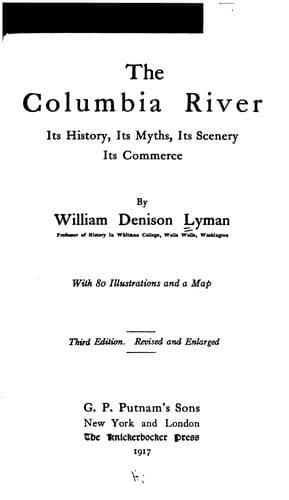
The Columbia River: Its History, Its Myths, Its Scenery, Its CommerceLyman, William Denison
History
The Columbia River: Its History, Its Myths, Its Scenery, Its Commerce
Lyman, William Denison
Columbia River; Columbia River -- Description and travel; Columbia River -- History
Journey of the Nez Perce Chiefs to Find the White Man's Book of
Life--Interest Excited among Christian People by this Event--Methodist
Church Leads in Preparing for a Missionary Party--Jason Lee and his
Mission near Chemeketa--The Reinforcement by the
_Lausanne_--Importance of Jason Lee as a Force in Oregon History--The
Missions of the American Board at Walla Walla, Lapwai, and
Tshimakain--Preliminary Journey of Whitman and Parker in 1835--The
Wedding Journey from Missouri to the Columbia in 1836--Dr. Whitman and
his Associates and their Traits of Character--On the Summit of South
Pass--Whitman's Waggon--Arrival at Vancouver and Conference with
McLoughlin--Locations of the Missionaries--Reinforcement in
1838--Friendship of the Nez Perces--First Printing Press--Whitman's
Ride in 1842-43--The Catholic Missions--Fathers Blanchet, Demers, and
De Smet--Influence of the Missions.
In 1832 a strange thing happened. Four Indians appeared in St. Louis
seeking the "White Man's Book of Life." At that time General William Clark
was superintendent of Indian affairs, located at St. Louis. He was
familiar with the Western Indians and had greatly sympathised with them.
Learning of these strange Indians and their stranger quest, General Clark
sought them, and entered into communication with them. It is usually
stated that these Indians were Flatheads from the Pend Oreille region, but
Miss Kate Macbeth, a missionary for many years to the Nez Perces, became
convinced that three were Nez Perces and the fourth a Flathead. How they
had learned that the white man had a "Book of Life" is not known. Captain
Bonneville's journal states that Pierre Pambrun had given many of the
Oregon Indians instruction in the rudiments of the Catholic worship. Some
have conjectured that Jedediah Smith, a noted American trapper, and, most
remarkable of all, a devout Christian, may have imparted religious
thoughts to them. Miss Macbeth believed that the motive of the mission was
to find Lewis and Clark, the explorers, whose visit in 1804-05 had
produced a profound impression on the Nez Perces. The first published
account of these four Indians appeared in the _New York Christian
Advocate_ for March 1, 1833. This was in the form of a letter from G. P.
Disoway, in which he enclosed a letter to himself from his agent, William
Walker, an interpreter for the Wyandotte Indians. Walker was at St. Louis
at the time, and met these four Indians in General Clark's office. He was
much impressed with their appearance, and learned that General Clark had
given them as full an account as possible of the nature and history of
man, of the advent of the Saviour, and of His work for men. Walker states
that two of the four men died in St. Louis, and as to whether the others
reached their native land he did not know.
Public-domain text, read in full here on John Shaqi.
Reviews
Reviews
No reviews yet
Be the first to share your thoughts on this work.
Elsewhere in the archive
Join the Discussion
Join the discussion
Sign in to leave a comment or review.
Sign InorCreate an account