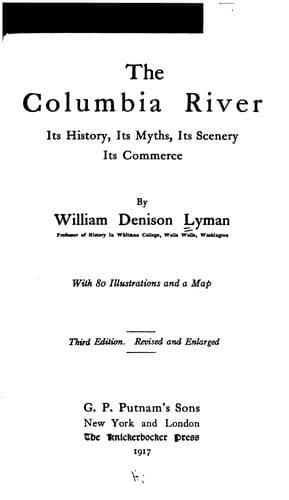
The Columbia River: Its History, Its Myths, Its Scenery, Its CommerceLyman, William Denison
History
The Columbia River: Its History, Its Myths, Its Scenery, Its Commerce
Lyman, William Denison
Columbia River; Columbia River -- Description and travel; Columbia River -- History
The Methodist Church was first to take up the work of sending forth
missionaries to the Oregon Indians. To Wilbur Fiske of Wesleyan University
seems due the credit of the first move. He enlisted the interest of Jason
Lee, a former student at Wesleyan University, but then engaged in
missionary work in the province of Quebec. Lee was a tall, athletic young
man, full of zeal and consecration, not polished or graceful in manner,
but powerful in spirit. He grasped at once the great possibilities in the
proposition of Dr. Fiske, and, going to Boston, became appointed by the
New England Conference as superintendent of a mission to Oregon. Daniel
Lee, Cyrus Shepard, and P. L. Edwards were named his associates.
In 1834, this mission band learned that Nathaniel Wyeth, famous as a
fur-trader, was expecting to cross the continent, sending his goods by the
brig _May Dacre_ to the Columbia River. Such an opportunity was too
favourable to be lost, and the Methodist Board at once opened negotiations
with Captain Wyeth, with the result that this first missionary company to
Oregon went with him and arrived safely at Vancouver on the Columbia, the
headquarters of the Hudson's Bay Company. The _May Dacre_ reached her
destination soon after, and thus Mr. Lee and his comrades found themselves
at the threshold of their labours. The first intention had been to locate
among the Nez Perces and Flatheads, the ones from whom the Macedonian cry
had gone up. But Dr. McLoughlin, the chief factor at Vancouver, who had
received them with the utmost interest and cordiality, persuaded them that
the Willamette Valley would be a more promising field. Its advantages were
obvious. It was directly on water navigation to the sea, and within easy
distance of it. It was so near the chief entrepot of the Hudson's Bay
Company as to be comparatively safe and accessible to all mails. The
valley was of extraordinary scenic charm and salubrious climate. The
natives, moreover, seemed more tractable and peaceful than those of the
upper valley. Accordingly the Methodist brethren ascended the Willamette
to a point near a group of farms which had been located by French
employees of the Hudson's Bay Company on what is known now as French
Prairie. One of these Frenchmen was Joseph Gervais, and from him the
subsequent town of Gervais was named. The mission was located on the
Willamette near Chemawa, the present site of the United States Indian
School. It was ten miles north of Chemeketa, which was the great Indian
Council Ground, or Peace Ground, from which fact the missionary applied to
it the name of Salem,--a change of name more commendable for piety than
for taste.
Public-domain text, read in full here on John Shaqi.
Reviews
Reviews
No reviews yet
Be the first to share your thoughts on this work.
Elsewhere in the archive
Join the Discussion
Join the discussion
Sign in to leave a comment or review.
Sign InorCreate an account