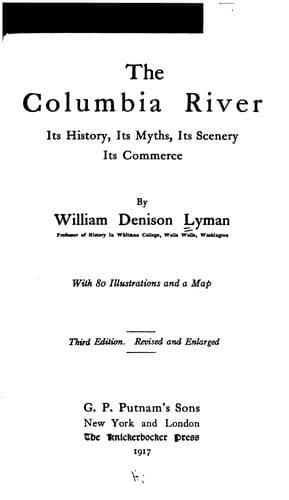
The Columbia River: Its History, Its Myths, Its Scenery, Its CommerceLyman, William Denison
History
The Columbia River: Its History, Its Myths, Its Scenery, Its Commerce
Lyman, William Denison
Columbia River; Columbia River -- Description and travel; Columbia River -- History
Jason Lee set to work at once with zeal, patience, and intelligence, to
inaugurate the work to which he had consecrated his life. At times his
efforts seemed to be well rewarded. Then pestilence would attack the
Indians, followed by suspicion and excitement, as a result of which all
the gains would be lost. The work among the whites and their half-breed
families was more encouraging than that with the Indians. At the best,
Indians have been inconstant and unreliable in respect to religious
instruction.
In 1837 a strong reinforcement arrived, among whom were Dr. Elijah White,
destined to become a man of note as Superintendent of Indian Affairs.
In 1838, Rev. Daniel Lee and Rev. H. K. W. Perkins established a new
station at Wascopum, now the location of The Dalles. In the same year
Jason Lee returned East to secure an addition to the mission. His efforts
were crowned with success. Five missionaries, one physician, six
mechanics, four farmers, one steward, and four female teachers, with a
number unclassified,--in all thirty-six adults and seventeen
children,--reached the Columbia River on the good ship _Lausanne_, under
charge of Captain Spalding, on May 21, 1840. This was the most notable
company that had yet reached our Great River. Among them were men and
women who contributed in a great degree to the subsequent growth of
Oregon. Of the number were Revs. Gustavus Hines, Alvin Waller, J. P.
Richmond, and J. H. Frost; Dr. Ira L. Babcock, George Abernethy,
afterwards governor of the territory, J. L. Parrish, and L. H. Judson. All
the men were accompanied by their wives, and most of them had children.
They were, in short, the advance guard of the American home-builders in
Oregon, and as such they deserve a special place on the roll of honour.
With this added force, it was possible to enlarge the work, in both
secular and religious lines, both among the whites and the Indians. A
mission was started at Clatsop on the south side of the mouth of the
Columbia under Mr. Parrish, one at the falls of the Willamette, and
another on Tualatin Plains, under Mr. Hines, while still another was
located by Mr. Richmond at Nisqually on Puget Sound.
As time passed on, it became more and more evident that this work was to
become less for Indians and more for the incoming whites. The whole aspect
of it changed. The Methodist Board in New England decided that they were
not justified in maintaining the missions, and these were discontinued
during the decade of the forties.
Out of the mission at Chemeketa grew Willamette University, one of the
most prominent educational institutions of Oregon.
Public-domain text, read in full here on John Shaqi.
Reviews
Reviews
No reviews yet
Be the first to share your thoughts on this work.
Elsewhere in the archive
Join the Discussion
Join the discussion
Sign in to leave a comment or review.
Sign InorCreate an account