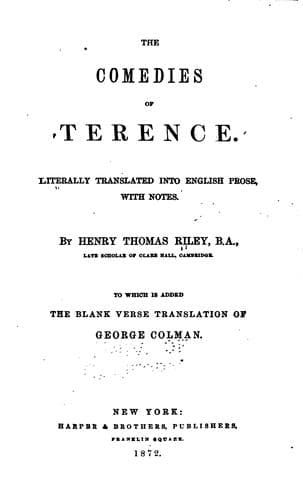
The Comedies of Terence: Literally Translated into English Prose, with NotesTerence
General
The Comedies of Terence: Literally Translated into English Prose, with Notes
Terence
Latin drama (Comedy) -- Translations into English; Terence -- Translations into English
[Footnote 18: _While one implored_)--Ver. 8. “Et eam plorare,
orare ut subveniat sibi.” This is probably in allusion to some
absurd passage in one of the Plays of Lavinius. It is generally
supposed to mean, that the stag implores the young man; but as the
youth is mad, the absurdity, of the passage is heightened if we
suppose that he implores the stag, and, in the moment of its own
danger, entreats it to come to his own assistance; as certainly
the Latin will admit of that interpretation. --Ovid has a somewhat
similar passage in the Pontic Epistles, B. ii. Ep. ii. l. 39: “The
hind that, in its terror, is flying from the savage dogs,
hesitates not to trust itself to the neighboring house.”]
[Footnote 19: _Epidicazomenos_)--Ver. 25. A Play of Apollodorus,
so called from that Greek word, signifying “one who demands
justice from another,” in allusion to Phormio, who is the
complainant in the suit, which is the foundation of the plot.]
[Footnote 20: _Was driven from the place_)--Ver. 32. Alluding,
probably, to the disturbances which took place at the first
representation of the Hecyra, and which are mentioned in the
Prologues to that Play.]
[Footnote 21: _Davus_)--Davus is a protatic character, only
introduced for the purpose of opening the story.]
[Footnote 22: _Out of his allowance_)--Ver. 43. Donatus tells us
that the slaves received four “modii,” or measures of corn, each
month, which was called their “demensum.”]
[Footnote 23: _Will be struck_)--Ver. 48. “Ferietur.” “To strike”
a person for a present was said when it was extorted from him
reluctantly. So in the Trinummuns of Plautus, l. 247, “Ibi illa
pendentem ferit.” “Then does she strike while he is wavering.”]
[Footnote 24: _For another present_)--Ver. 48. Presents were
usually made to persons on their birthday, on the day of their
marriage, and on the birth of their children.]
[Footnote 25: _Initiate him_)--Ver. 49. It is not known what
initiation is here referred to. Madame Dacier thinks it was an
initiation into the great mysteries of Ceres, which was commonly
performed while children were yet very young; others suggest that
it means the period of weaning the child, and initiating it into
the use of another kind of diet. Donatus says, that Varro speaks
of children being initiated into the mysteries of the Deities
Edulia, Potica, and Cuba, the Divinities of Eating, Drinking, and
Sleeping.]
[Footnote 26: _Ready counted out_)--Ver. 53. “Lectum,” literally
“picked out” or “chosen”-- the coins being of full weight.]
[Footnote 27: _Have been angry with me_)--Ver. 74. He alludes to
the common belief that each person had a Genius or Guardian Deity;
and that when misfortune overtook him, he had been abandoned by
his Genius.]
Public-domain text, read in full here on John Shaqi.
Reviews
Reviews
No reviews yet
Be the first to share your thoughts on this work.
Elsewhere in the archive
Join the Discussion
Join the discussion
Sign in to leave a comment or review.
Sign InorCreate an account