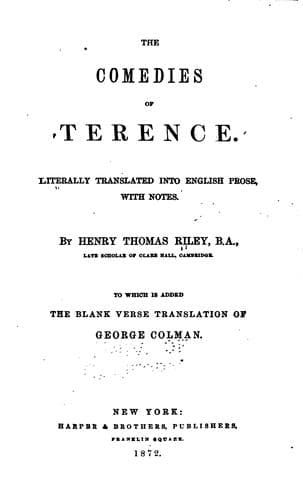
The Comedies of Terence: Literally Translated into English Prose, with NotesTerence
General
The Comedies of Terence: Literally Translated into English Prose, with Notes
Terence
Latin drama (Comedy) -- Translations into English; Terence -- Translations into English
[Footnote 28: _Kick against the spur_)--Ver. 78. “To kick against
the pricks,” or “in spite of the spur,” was a common Greek
proverb. The expression occurs in the New Testament, Acts ix. 5.
“It is hard for thee to kick against the pricks.”]
[Footnote 29: _To make your market_)--Ver. 79. This is a
metaphorical expression taken from traffic, in which merchants
suit themselves to the times, and fix a price on their
commodities, according to the course of the market.]
[Footnote 30: _To the school_)--Ver. 86. It was the custom for the
“lenones,” or “procurers,” to send their female slaves to
music-schools, in order to learn accomplishments. So in the
Prologue to the Rudens of Plautus: “This Procurer brought the
maiden to Cyrene hither. A certain Athenian youth, a citizen of
this city, beheld her us she was going home from the
music-school.”]
[Footnote 31: _Young man in tears_)--Ver. 92. In the Play of
Apollodorus, it was the barber himself that gave the account how
he had just returned from cutting off the young woman’s hair,
which was one of the usual ceremonies in mourning among the
Greeks. Donatus remarks, that Terence altered this circumstance
that he might not shock a Roman audience by a reference to manners
so different from their own.]
[Footnote 32: _Take out a summons_)--Ver. 127. “Dica” was the writ
or summons with which an action at law was commenced.]
[Footnote 33: _Usher to the Music-girl_)--Ver. 144. This is said
satirically of Phaedria, who was in the habit of escorting the
girl to the music-school. It was the duty of the “pædagogi,” or
“tutors,” to lead the children to school, who were placed under
their care. See the speech of Lydus, the pædagogus of Pistoclerus,
in the Bacchides of Plautus, Act iii. Sc. 3, where, enlarging upon
his duties, he mentions this among them.]
[Footnote 34: _Sever from me this connection_)--Ver. 161. By
forcing him to divorce her.]
[Footnote 35: _Neither right_)--Ver. 176. No right to get rid of
her in consequence of the judgment which, at the suit of Phormio,
has been pronounced against him; nor yet, right to keep her,
because of his father insisting upon turning her out of doors.]
[Footnote 36: _Be washing a brickbat_)--Ver. 187. “Laterem
lavare,” “to wash a brick,” or “tile,” was a proverb signifying
labor in vain, probably because (if the brick was previously
baked) it was impossible to wash away the red color of it.
According to some, the saying alluded to the act of washing a
brick which had been only dried in the sun, in which case the
party so doing both washed away the brick and soiled his own
fingers.]
[Footnote 37: _Here in reserve_)--Ver. 230. “Succenturiatus.” The
“succenturiati” were, properly, men intrusted to fill up vacancies
in the centuries or companies, when thinned by battle.]
Public-domain text, read in full here on John Shaqi.
Reviews
Reviews
No reviews yet
Be the first to share your thoughts on this work.
Elsewhere in the archive
Join the Discussion
Join the discussion
Sign in to leave a comment or review.
Sign InorCreate an account