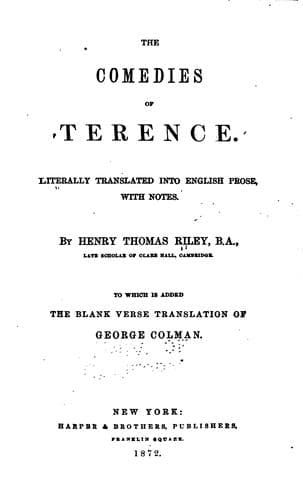
The Comedies of Terence: Literally Translated into English Prose, with NotesTerence
General
The Comedies of Terence: Literally Translated into English Prose, with Notes
Terence
Latin drama (Comedy) -- Translations into English; Terence -- Translations into English
[Footnote 57: _Much more at a loss_)--Ver. 459. See the Poenulus
of Plautus, where advocates or assistants are introduced among the
Dramatic Personæ. Colman has the following remarks on this quaint
passage: “I believe there is no Scene in Comedy more highly
seasoned with the {ridiculous} than this before us. The idea is
truly comic, and it is worked up with all that simplicity and
chastity so peculiar to the manner of Terence. An ordinary writer
would have indulged himself in twenty little conceits on this
occasion; but the dry gravity of Terence infinitely surpasses, as
true humor, all the drolleries which, perhaps, even those great
masters of Comedy, Plautus or Molière, might have been tempted to
throw out. It is the highest art of a Dramatic Author, on some
occasions, to leave a good deal to the Actor; and it has been
remarked by Heinsius and others, that Terence was particularly
attentive to this circumstance.”]
[Footnote 58: _From his place of exercise_)--Ver. 484. “Palæstra.”
He alludes to the Procurer’s house under this name.]
[Footnote 59: _Befall his own safety_)--Ver. 490. Overhearing
Phædria earnest and determined, and the Procurer obstinate and
inflexible, Antipho and Geta join in apprehending that the
brutality of the latter may provoke Phædria to some act of
violence.]
[Footnote 60: _With fine words_)--Ver. 499. “Phaleratis dictis.”
“Phaleræ” were, properly, the silver ornaments with which horses
were decked out, and being only for show, and not for use, gave
rise to this saying. “Ductes” was an obscene word, and not likely
to be used by any but such characters as Dorio.]
[Footnote 61: _A wolf by the ears_)--Ver. 505. A proverbial
expression which, according to Suetonius, was frequently in the
mouth of Tiberius Cæsar.]
[Footnote 62: _A word to the wise_)--Ver. 540. “Dictum sapienti
sat est.” The same proverb is found in the Persa of Plautus,
l. 736.]
[Footnote 63: _To shake myself_)--Ver. 585. “Me excutiam.” In
reference to the custom of the Greeks, and the Eastern nations, of
shaking their clothes at the door of any house which they were
going to leave.]
[Footnote 64: _Rely on at home_)--Ver. 586. “Nam ego meorum solus
sum meus.” He means that he is the only person in his house
friendly to himself, inasmuch as his wife, from her wealth, has
supreme power over the domestics, in whom he himself can place no
trust.]
[Footnote 65: _Good terms with him_)--Ver. 635. Meaning, “Is he in
his senses or not?”]
[Footnote 66: _Amount of his life_)--Ver. 660. “Quid si animam
debet?” Erasmus tells us that this was a proverb among the Greeks
applied to those who ran so deeply in debt, that their persons,
and consequently, in one sense, their very existence, came into
the power of their creditors.]
Public-domain text, read in full here on John Shaqi.
Reviews
Reviews
No reviews yet
Be the first to share your thoughts on this work.
Elsewhere in the archive
Join the Discussion
Join the discussion
Sign in to leave a comment or review.
Sign InorCreate an account