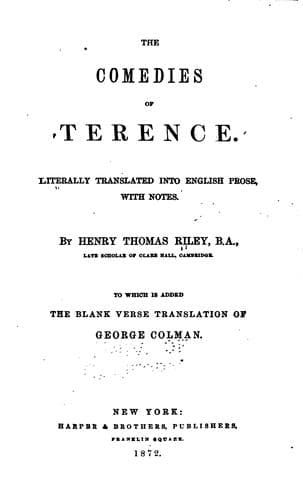
The Comedies of Terence: Literally Translated into English Prose, with NotesTerence
General
The Comedies of Terence: Literally Translated into English Prose, with Notes
Terence
Latin drama (Comedy) -- Translations into English; Terence -- Translations into English
[Footnote 67: _Six hundred actions_)--Ver. 667. “Sescentos;”
literally, “six hundred.” The Romans used this term as we do the
words “ten thousand,” to signify a large, but indefinite number.]
[Footnote 68: _A strange black dog_)--Ver. 705. This omen, Plautus
calls, in the Casina, l. 937, “canina scæva.”]
[Footnote 69: _Through the sky-light_)--Ver. 706. So in the
Amphitryon of Plautus, l. 1108, two great snakes come down through
the “impluvium,” or “sky-light.” On the subject of the
“impluvium,” see the Notes to the Miles Gloriosus of Plautus,
l. 159.]
[Footnote 70: _A hen crowed_)--Ver. 707. Donatus tells us that it
was a saying, that in the house where a hen crowed, the wife had
the upper hand.]
[Footnote 71: _The soothsayer-- the diviner_)--Ver. 708. According
to some accounts there was this difference between the “hariolus”
and the “aruspex,” that the former foretold human events, the
latter those relating to the Deities. Donatus has remarked on
these passages, that Terence seems to sneer at the superstitions
referred to.]
[Footnote 72: _Can find them now_)--Ver. 726. His Lemnian wife and
daughter. Colman remarks: “This is intended as a transition to the
next Scene; but I think it would have been better if it had
followed without this kind of introduction. The Scene itself is
admirable, and is, in many places, both affecting and comic, and
the discovery of the real character of Phanium is made at a very
proper time.”]
[Footnote 73: _My daughter’s nurse_)--Ver. 735. Among the
ancients, it was the custom for nurses who had brought up children
to remain with them in after-life.]
[Footnote 74: _Where are the ladies?_)--Ver. 748. “Ubi illæ?”
literally, “Where are these women?”]
[Footnote 75: _Run beyond the house_)--Ver. 767. “Fugias ne præter
casam.” This passage has given much trouble to the Commentators;
but it is pretty clear that the explanation of Donatus is the
correct one: “Don’t abandon your own home,” that being the safest
place. Stallbaum agrees with Gronovius in thinking that it was
first applied as a piece of advice to runaway slaves, as being
likely to become worse off by the change; probably much in the
same spirit as we say, “Out of the frying-pan into the fire.”]
[Footnote 76: _Paying by borrowing_)--Ver. 779. “Versura solvere,”
was “to pay a debt by borrowing money,” and consequently to be no
better off than before. Geta having, by the money he has procured,
freed Phædria from all danger of losing his mistress, but at the
same time having brought Antipho into still greater danger of
losing his wife.]
[Footnote 77: _Or his talking_)--Ver. 782. “Ejus” here alludes,
not to Nausistrata but to Phormio. Madame Dacier suggests that it
should be “hujus.”]
Public-domain text, read in full here on John Shaqi.
Reviews
Reviews
No reviews yet
Be the first to share your thoughts on this work.
Elsewhere in the archive
Join the Discussion
Join the discussion
Sign in to leave a comment or review.
Sign InorCreate an account