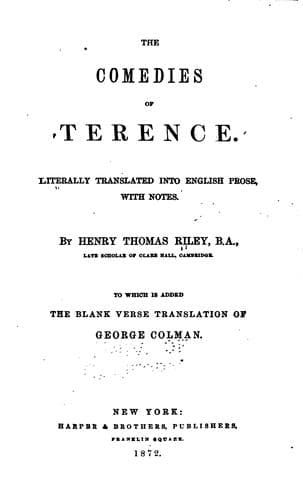
The Comedies of Terence: Literally Translated into English Prose, with NotesTerence
General
The Comedies of Terence: Literally Translated into English Prose, with Notes
Terence
Latin drama (Comedy) -- Translations into English; Terence -- Translations into English
[Footnote 88: _Dead and gone_)--Ver. 965. “E medio excedere,” was
an Euphemism signifying “to die,” which it was deemed of ill omen
to mention.]
[Footnote 89: _Those who have_)--Ver. 1025. He here uses the terms
which it was customary to employ in the celebration of a public
funeral. See also the form of proclaiming an auction, at the end
of the Menæchmi of Plautus.]
[Footnote 90: _Have him victimised_)--Ver. 1027. “Mactatus” was
the term applied to the pouring of wine and frankincense on the
victim about to be sacrificed, on which it was said to be “magis
auctus,” “increased,” or “amplified;” which, in time, became
corrupted into the word “mactatus,” or “mactus.”]
[Footnote 91: _Grant us your applause_)--Ver. 1054. Thus concludes
the last, and certainly not the least meritorious of the Plays of
our Author; indeed, for genuine comic spirit, it may challenge
comparison with the Eunuch, which is in general considered to be
the best.]
* * * * *
* * * *
* * * * *
Errors and Inconsistencies (Noted by transcriber)
The variation between “Augustin” and “Augustine” (St.) is unchanged.
Unless otherwise noted, errors found in the New York (Harper) edition
are also present in the London (Bell/Bohn) edition.
Andria:
CHREM. But how say you----? [extraneous close quote at end]
Footnote 83... She speaks of “liberæ,” “free women,”
[in Harper edn. only, second open quote missing]
Footnote 90... to tie criminals hands and feet together
[no apostrophe after ”criminals”; grammatical intent is
ambiguous]
Eunuch:
Footnote 10... From δόναξ, “a reed.” [δόνὰξ with extra accent]
Footnote 33... these words, commencing with “Sane, quia vero,”
[Harper edn. has “conmencing”]
Self-Tormentor:
CHREM. ...I opened all the casks, all the vessels;[56]
[footnote tag missing in Bell/Bohn;
Harper has extraneous close quote instead]
Adelphi:
Footnotes 14-16 --This Play [page printed without dashes in
footnotes]
DEM. {Æschinus}, if you are a man, he’ll do it.
[final period missing in Harper]
Hecyra:
Footnote 57... contradicts himself?
[Harper edn. has extraneous close quote]
Public-domain text, read in full here on John Shaqi.
Reviews
Reviews
No reviews yet
Be the first to share your thoughts on this work.
Elsewhere in the archive
Join the Discussion
Join the discussion
Sign in to leave a comment or review.
Sign InorCreate an account