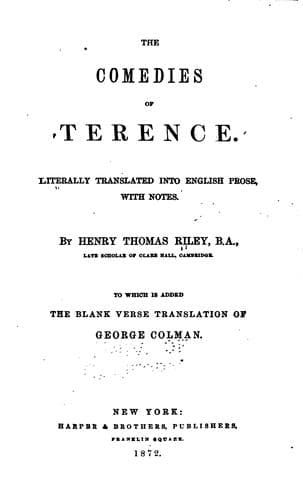
The Comedies of Terence: Literally Translated into English Prose, with NotesTerence
General
The Comedies of Terence: Literally Translated into English Prose, with Notes
Terence
Latin drama (Comedy) -- Translations into English; Terence -- Translations into English
[Footnote 78: _With your money_)--Ver. 785. Colman observes:
“Alluding to the money borrowed of her to pay Phormio; and as
Donatus observes in another place, it is admirably contrived, in
order to bring about a humorous catastrophe that Chremes should
make use of his wife’s money on this occasion.”]
[Footnote 79: _Our friend’s_)--Ver. 811. Chremes himself is so
called, to deceive Nausistrata.]
[Footnote 80: _O good luck_)--Ver. 840. “Fors fortuna,” “good
fortune;” while “fortuna” merely means “chance.”]
[Footnote 81: _Throwing my cloak_)--Ver. 843. When expedition was
required, it was usual to throw the ends of the “pallium,” or
“cloak,” over the shoulders.]
[Footnote 82: _Carry me off_)--Ver. 881. Madame Dacier says that
Antipho is so rejoiced here at Geta’s news, that he jumps upon his
shoulders, and is carried off in triumph, which was a sort of
stage-trick, and was very diverting to the Audience. On this,
Colman observes: “I believe Madame Dacier has not the least
foundation for this extraordinary piece of information; and I must
confess, that I have too high an opinion, both of the Roman
audience and actors, to believe it to be true.”]
[Footnote 83: _That as to what_)--Ver. 898. Lemaire suggests that
he is about to say: “that as to what was agreed upon between us,
I may take home this young woman, and make her my wife.”]
[Footnote 84: _Is she not genteel-looking_)--Ver. 904. Patrick has
the following note here: “One can not conceive any thing more
happy or just than these words of Chremes. Demipho’s thoughts are
wholly taken up how to recover the money, and Phormio is equally
solicitous to retain it; but Chremes, who had just left his
daughter, is regardless of their discourse, and fresh from the
impressions which she had made on him, longs to know if his
brother’s sentiments of her were equally favorable, and naturally
puts this paternal question to him.”]
[Footnote 85: _Transferred to my account_)--Ver. 921. “Rescribere
argentum,” or “nummos,” meant “to transfer,” or “set down money to
the account of another person in one’s banker’s books.” A passage
in the Asinaria of Plautus, l. 445, seems to have the same
meaning.]
[Footnote 86: _For the well portioned_)--Ver. 939. Though Colman
thinks otherwise, it is pretty clear that he alludes to
Nausistrata in these words.]
[Footnote 87: _To be carrying off_)--Ver. 954. Patrick has the
following note here: “The different characters of the two brothers
are admirably preserved throughout this Scene. Chremes stands
greatly in awe of his wife, and will submit to any thing rather
than the story should come to her ears; but Demipho can not brook
the thoughts of losing so much money, and encourages his brother
to behave with spirit and resolution, promising to make up matters
between him and his wife.”]
Public-domain text, read in full here on John Shaqi.
Reviews
Reviews
No reviews yet
Be the first to share your thoughts on this work.
Elsewhere in the archive
Join the Discussion
Join the discussion
Sign in to leave a comment or review.
Sign InorCreate an account