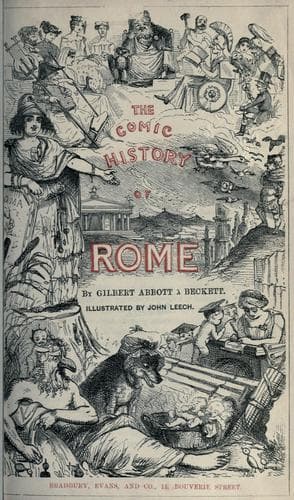
The Comic History of RomeÀ Beckett, Gilbert Abbott
History
The Comic History of Rome
À Beckett, Gilbert Abbott
Rome -- History -- Humor; Wit and humor, Pictorial
The Senate, unable to maintain any charge, and tired, perhaps, of the
expense of keeping him in prison, sent him forth to maintain himself at
his own charge; but his means having been greatly reduced, he found a
corresponding reduction in his popularity. While his resources flowed in
a golden stream, he was a rich pump that any one was ready to make a
handle of; but no sooner did the supply fall off, and the pump cease to
act, than he was left destitute of the commonest succour. He was
eventually brought to trial; and being called upon for his defence, he
produced four hundred insolvents whose debts he had paid--and who passed
through the Court of Justice--as witnesses to his liberality. He then
showed his wounds, which were not the sore places of which the
patricians complained; and he ultimately pointed to the Capitol, in the
preservation of which he had acquitted himself so well, that on the
recollection of it, his acquittal was pronounced by the citizens. His
persecutors, however, obtained a new trial, upon which he was condemned
to death; and a slave having been sent with the despatch containing the
news, proceeded to the despatch of Manlius himself in a treacherous
manner. Proposing a walk along the cliff, under the pretence of
friendship, the slave gradually got Manlius near the edge, until the
latter suddenly found himself driven to the last extremity. Upon this he
received a push which sent him down the Tarpeian Rock; and the man who
pretended to have come as a friend, had been base enough to throw him
over. The sudden idea of the traitor was afterwards carried into
frequent execution; for the practice he had commenced, was subsequently
applied to the execution of criminals.
After the death of Manlius, his house was levelled with the ground, and
he himself experienced the fate of most men when thoroughly down, for he
was repudiated even by his own family. The gens, or gents, of the
Manlii, with a contemptible want of manliness, resolved that none of the
members should ever bear the name of Marcus, which they avoided as a
mark of disgrace, though at one time it had been a title of honour.
Rome seemed now to be declining, and going down all its seven hills at
once; pestilence killed some, and gave the vapours to others, and the
sewers no longer fulfilled their office, but overflowing, in consequence
of the irregular rebuilding of the city, they threw a damp upon the
inhabitants. The free population was growing daily less, while the
number of patricians continued the same, and there seemed reason to fear
that Rome would soon become one of those most inconvenient of
oligarchies, in which there are many to govern and comparatively few to
be governed. The "eternal city" was in danger of being prematurely cut
off by an early decline, for its constitution was not yet matured; and
though it had once been saved by mere quackery,[25] it was now to be
preserved by a bolder and wiser regimen.
FOOTNOTES:
Public-domain text, read in full here on John Shaqi.
Reviews
Reviews
No reviews yet
Be the first to share your thoughts on this work.
Elsewhere in the archive
Join the Discussion
Join the discussion
Sign in to leave a comment or review.
Sign InorCreate an account