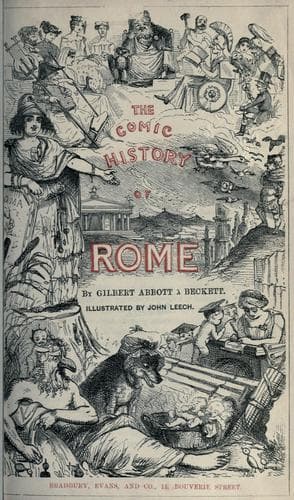
The Comic History of RomeÀ Beckett, Gilbert Abbott
History
The Comic History of Rome
À Beckett, Gilbert Abbott
Rome -- History -- Humor; Wit and humor, Pictorial
[24] These geese were sacred to Juno, who was the goddess of marriage;
but we cannot say whether the goose became identified with her on that
account.
[25] See _ante_, the anecdote of the Sacred Geese.
CHAPTER THE TENTH.
FROM THE TRIBUNESHIP OF C. LICINIUS TO THE DEFEAT OF THE GAULS BY
VALERIUS.
[Illustration: Roman Soldier.]
Rome was now overwhelmed with debt, and fresh taxes were imposed to
rebuild the wall of stone; but it would have been as easy to have got
blood out of the stones themselves, as money from the pockets of the
people. The more they went on not paying, the more were they called upon
to pay; and ruin appeared inevitable, until it occurred to the great
financial reformers of the day that there can be no permanent balance to
the credit of a state without a due adjustment of the balance of power.
Happily for the interests of humanity, there is scarcely ever a crisis
requiring a hero, but there is a hero for the crisis,--no situation
demanding a man, without a man for the situation; and though there may
be on hand a formidable list of those who perpetually "Want places," we
have the consolation of feeling that when there is a vacant place to be
filled up, there is no lack of the material required to fill it.
The man for the situation in which Rome then happened to be, was a
certain C. Licinius, who had married the younger daughter of the
patrician, M. Fabius. The lady was considered to have wed below her
station, and the Roman noses of her relatives were converted into snubs,
by the habit of turning up for the purpose of snubbing her. Being on a
visit with her sister, who was the wife of Servius Sulpicius, the
Consular Tribune, she was one day alarmed by such a knocking at the door
as she had never yet heard, and on inquiring the cause, she found that
the lictors of old, like the modern footmen, were in the habit of
estimating, by the number of raps he was worth, the dignity of their
master. The elder Fabia, perceiving her sister's surprise, took the
opportunity of administering a rap on the knuckles, through the medium
of the knocker, and observed, that if the latter had not married a low
plebeian, she would have been accustomed to hearing her own husband
knock as loud, instead of being obliged to knock under.
The vanity of Fabia had received a blow which had deprived her of sense;
and the effect of the knocking at the door had been so stunning, that
she could scarcely call her head her own. She was resolved that her
husband should make as much noise in the world as her brother-in-law,--
that he should gain an important post, and win the privilege of knocking
as violently as he chose at his own threshold.
[Illustration: Miss Fabia, the Younger, astonished at the Patrician's
double-knock.]
Public-domain text, read in full here on John Shaqi.
Reviews
Reviews
No reviews yet
Be the first to share your thoughts on this work.
Elsewhere in the archive
Join the Discussion
Join the discussion
Sign in to leave a comment or review.
Sign InorCreate an account