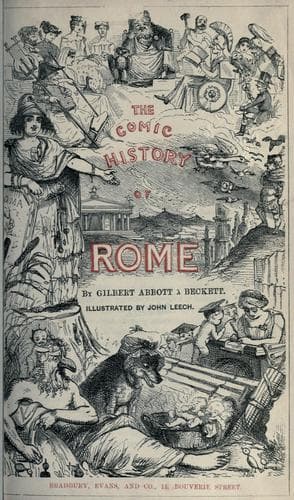
The Comic History of RomeÀ Beckett, Gilbert Abbott
History
The Comic History of Rome
À Beckett, Gilbert Abbott
Rome -- History -- Humor; Wit and humor, Pictorial
Aided by the manœuvre of the Mus, the success of Valerius was complete:
the Samnites fled in such consternation that they left behind them
40,000 shields and 170 standards; so that the Romans must have found the
way literally paved with the flags of the vanquished. A triumph was
decreed to both the Consuls, and foreign nations sent to congratulate
the Romans on their success; the Carthaginians forwarding a crown of
gold, twenty-five pounds in weight, the mere cartage of which from
Carthage must have been costly and difficult. Compliments poured in upon
the conquerors from every side; for good fortune increases the number of
addresses to a state, just as the success of an individual causes a
sensible, or rather a senseless, addition to the contents of his
card-basket. Rome was inundated with calls upon her--many of which were
for assistance from feeble countries, whose weak states seemed to be
threatened with speedy dissolution.
[Illustration: A Scare-crow.]
It was about this time (B.C. 342) that the garrison at Capua broke out
into revolt, arising, it is said, from the fact that Capua was extremely
rich, and the soldiers very poor; that the latter were hopeless debtors,
and forgot what they owed their country in the vast sums they owed to
their creditors. The story goes on to say, that a corps of heavy
insolvents first originated the idea of sacking the city and bagging its
wealth, by placing it among their own baggage. The Consul, C. Martius
Rutilius, was sent to take the command, and he attempted the soothing
system; but the soldiers were goaded with the fetters of debt, and
refused to be smoothed over, or to submit to remain under irons. Being
in want of a leader, they seized on T. Quinctius, an aged veteran, whose
head was so completely bowed down, that he could not do otherwise than
bow when asked if he would lead them as their general. The nod of palsy
was interpreted into the nod of assent, and T. Quinctius was selected to
oppose Corvus, or the Crow, though the only chance for the veteran was,
that in the capacity of a scare-crow he might succeed in frightening his
antagonist. The armies at length met, when the insurgents, led by a
shivering veteran, began to follow their leader, and to shake with fear,
which induced Valerius to offer them terms, and the quaking Quinctius
was the first to recommend his troops to accept an amnesty. Thus ended
an insurrection, of which the motive appears vague, and the management
thoroughly contemptible. The best opinion of its origin seems to be,
that the army abounded in debtors, who were afraid to go home, and who
preferred the chances of a mutiny to the certainty of having to meet
their creditors. The only concession they asked was the cancelling of
all their debts; a proposition that savours rather of the swindler than
the patriot. It is, however, an almost universal fact, that the
insolvent classes of a community are to be found in opposition to the
Public-domain text, read in full here on John Shaqi.
Reviews
Reviews
No reviews yet
Be the first to share your thoughts on this work.
Elsewhere in the archive
Join the Discussion
Join the discussion
Sign in to leave a comment or review.
Sign InorCreate an account