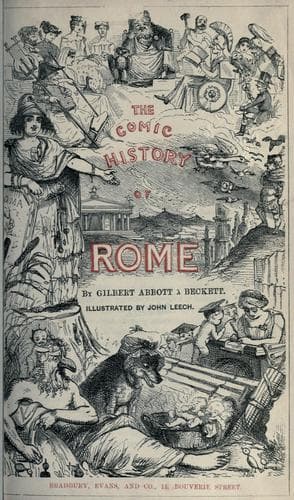
The Comic History of RomeÀ Beckett, Gilbert Abbott
History
The Comic History of Rome
À Beckett, Gilbert Abbott
Rome -- History -- Humor; Wit and humor, Pictorial
On this spot a battle ensued, which was fought with such fierceness on
the side of the Romans, that the Samnites afterwards declared they had
seen fire in their opponents' eyes; but the Samnites must have been
light-headed themselves, to have made so absurd a statement. Valerius
having been thus far successful, advanced into the Apennines, where,
what are called the mountain fastnesses, are rendered dangerous by those
occasional loosenesses of the earth that give rise to, or cause the fall
of, an avalanche. Though nothing of this sort fell upon him, he was
expecting the descent of the foe, which suddenly appeared on the topmost
heights, and came down with such a run, that the escape of the Romans
seemed impossible. In this difficult dilemma, a subordinate officer
proved to be the safeguard of the whole Roman army; and as the noble
lion, when netted to the profit of a bold hunter, was delivered by a
mouse, so was the noble-hearted Valerius indebted to P. Decius Mus for
the safety of himself and his followers. P. Decius laid, in fact, a
snare for the Samnites, who were caught in this trap of Mus, or military
mouse-trap. He climbed, with a little band, a height so narrow, that
large numbers could not reach it to dislodge him, though it was
necessary to keep an eye upon him; and, while the Mus attracted the
cat-like vigilance of the whole Samnite army, Valerius and his followers
were allowed to steal away unperceived to their own quarters.
When the enemy, tired with watching, had fallen asleep, Mus crept out,
as quietly as his name would imply, and reached his camp in safety. He
received immediately from the Consul an ox, with gilded horns, through
which he might trumpet his fame; and the soldiers presented him with a
_corona obsidionalis_--a crown made of blades of grass--in commemoration
of their having been gallantly rescued from the blades of the enemy. The
materials for a crown of this description were plucked on the spot, in
memory of the pluck shown on the spot by the gallant recipient. Such a
crown conveyed a finer lesson of morality than anything that the cold
brilliance of gold or jewels could suggest; for the wreath of grass,
converted, by the very sunshine in which it basked, into the dry and
lifeless hayband, told, in a few hours, the perishable nature of glory.
Public-domain text, read in full here on John Shaqi.
Reviews
Reviews
No reviews yet
Be the first to share your thoughts on this work.
Elsewhere in the archive
Join the Discussion
Join the discussion
Sign in to leave a comment or review.
Sign InorCreate an account