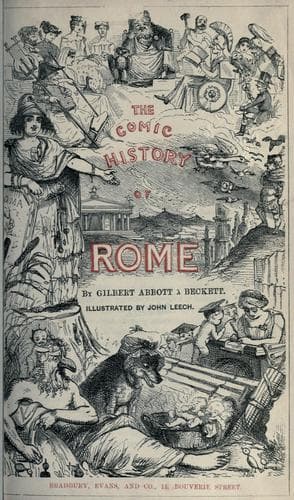
The Comic History of RomeÀ Beckett, Gilbert Abbott
History
The Comic History of Rome
À Beckett, Gilbert Abbott
Rome -- History -- Humor; Wit and humor, Pictorial
The two Consuls went forth to fight, and both commenced their campaign
by going to sleep, which led naturally to the inquiry, what they could
both have been dreaming about. So thoroughly sympathetic were they in
their drowsiness, that they had dreamed precisely the same dream, in
which each had seen a ghost, who had addressed both in the same spirit.
The spectre, who was decidedly on the shady side of existence, professed
through his lantern jaws to throw a light upon Rome's future destiny. He
told the Consuls that the general on one side was doomed; but, as this
was merely dealing with generalities, he went on to add, that the whole
army on one side was to be buried in the earth; a suggestion neither
side would be very anxious to fall in with. The spectre, who was rather
more communicative than spectres usually are, and who was not so
monosyllabic as a fair average ghost, proceeded to further explanations,
in the course of which he remarked, that "the general who first devoted
himself to the infernal gods, would, by that act of devotion, consign
the whole of the opposing army to" a most unpleasant neighbourhood. Both
agreed that the one whose army was the first to back out, should be the
first to rush into danger. The hostile armies accordingly began to
recede as far as they could, and the only contest was to ascertain who
could be the cleverest and quickest in walking in one direction, whilst
looking in another. It was an understood thing that nobody was to fight
unless first attacked, and the general aim was to avoid aiming at
anything. Foraging parties went out daily to try and provoke each other
to an onslaught, and the prevailing sentiment on both sides was a hope,
that "somebody would only just do so and so." Titus Manlius, the son of
Torquatus, approached the Latin camp, when Metius, of Tusculum,
attempted by all sorts of provoking signals to induce the raw youth to
commence a combat; but the boy for some time combated nothing but his
own inclination, which would have set him on to an onset. At length he
became so irritated that he could restrain himself no longer, but
hurling his javelin with all his might, it stuck in the mane of the
horse of Metius. The poor brute, looking for sympathy to his master,
fell back upon him for protection; but this act of affectionate
confidence was fatal to Metius, who, being brought to the ground, was
saddled with the whole weight of the unfortunate quadruped. Titus,
taking advantage of the position of Metius, stabbed him with his sword,
and the latter, feeling himself pierced, could only set up a piercing
cry, by way of retaliation upon his antagonist. Having stripped off the
armour of his victim, young Titus bore it in triumph to his father,
Torquatus Manlius, who proceeded to imitate Brutus; but, like most
imitations, the appearance of T. Manlius in the part of the "heavy
father" was by no means successful.
Public-domain text, read in full here on John Shaqi.
Reviews
Reviews
No reviews yet
Be the first to share your thoughts on this work.
Elsewhere in the archive
Join the Discussion
Join the discussion
Sign in to leave a comment or review.
Sign InorCreate an account