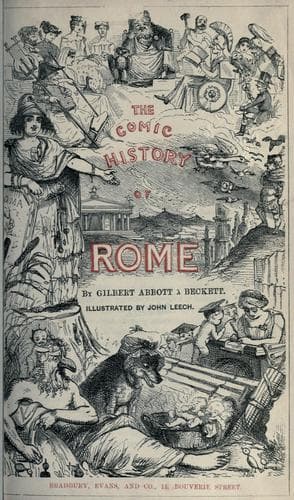
The Comic History of RomeÀ Beckett, Gilbert Abbott
History
The Comic History of Rome
À Beckett, Gilbert Abbott
Rome -- History -- Humor; Wit and humor, Pictorial
Collecting the troops by the sound of trumpet, so that the audience
might be sufficiently large, he threw himself into an imposing attitude;
but the imposition was seen through, and the reception he met with was
far from flattering. He next called forward his son, and denouncing him
as an officer who had disobeyed his governor in a double sense--his
father and his consul--the lictors were ordered to proceed, by the
execution of the son, to the execution of their duty. Manlius, having
witnessed the ceremony, buried his face in his toga, expecting at least
three rounds of applause; but the performance fell as dead as his
unhappy offspring. On his return to Rome he was universally cut by the
young men, who were peculiarly alive to a penalty that might be the
death of any one of them. The remains of young Manlius were collected
into a dreary pile, and the trophies he had illegally won were added as
the materials for a bonfire. His obsequies were the first of the same
kind among the Romans that we have been able to meet with, after a truly
industrious analysis of every hole in which the dust of ages might be
found, and a careful sifting of the ashes of antiquity.
The two armies were still standing, when Decius Mus, who was most
anxious to distinguish himself, and was watching intently to discover
which way the cat would jump, observed a backward movement among his
spearmen. His opportunity for glory had now arrived, and the gallant
Mus, rushing recklessly to the scratch, behaved himself less like a mus
than a lion in the conflict. He fell under a perfect shower of javelins,
and lay on the field literally _piqué_ with the pikes of his enemies.
The latter were dismayed, and his own friends animated by what had taken
place; but the rule of contraries must here have prevailed, for the
death of an adverse general should not have disheartened the Latins,
while the sacrifice of their own chief was, if looked at in a proper
light, but poor encouragement for the Romans. They, however, grew bold;
but it was scarcely necessary for them to strike a blow, as the Latins
yielded under the stroke of a panic. They fell in such numbers, that
three parts are said to have perished, and only a fourth of the army
remained to tell of the little quarter allowed them by the enemy.
Public-domain text, read in full here on John Shaqi.
Reviews
Reviews
No reviews yet
Be the first to share your thoughts on this work.
Elsewhere in the archive
Join the Discussion
Join the discussion
Sign in to leave a comment or review.
Sign InorCreate an account