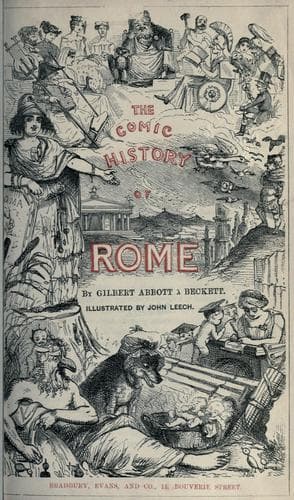
The Comic History of RomeÀ Beckett, Gilbert Abbott
History
The Comic History of Rome
À Beckett, Gilbert Abbott
Rome -- History -- Humor; Wit and humor, Pictorial
higher station, instead of its being a line drawn, as every line should
be, for the good of all;--when a household is in such a state, we may
see in it the type of a badly ordered community. Such had been long the
unhappy lot of Rome, until it began to strike on the minds of a few
influential men, that no nation can be really great while the mass of
its people are in a state of abject littleness. The majority of the
patricians fortunately took an equally sensible view of their case, and
arrived at the wise conclusion, that moderate privileges fairly held,
and freely conceded, are preferable to any amount of exclusive
advantage, improperly assumed on the one hand, and impatiently submitted
to on the other. Happily for the patricians, they had among them a man
bold enough to incorporate in a law the opinions of the main part of his
own order, and strong enough to prevail over the weakness and prejudice
of the meaner members of the body.
The name of this patrician reformer was Q. Publilius Philo, who
introduced three laws calculated to extend the basis of political
power. By the first, the _curiæ_, consisting of patricians only, were
compelled to confirm the laws passed by the centuries in which the two
orders were mixed; by the second, the _plebiscita_, or decrees of the
plebs, were to be binding on all Roman citizens; and the third provided,
that there should always be one plebeian censor. These laws, though,
perhaps, well adapted to the wants of the age, were not exactly such as
we should hail with enthusiasm if they were to be brought forward in our
own day by the head of a government. Depriving the curiæ of a veto was a
measure equivalent to a proposition that the measures of the House of
Commons should not require the concurrence of the House of Lords; and
giving the force of law to a _plebiscitum_ was much the same thing as
determining that every resolution of every public meeting should at once
be embodied in the statute-book. Such an arrangement in the present day
would render our laws a curiosity of legislative mosaic work, laid down
without the advantage of uniformity or design. If the interpretation of
an act of Parliament is sometimes difficult, we may conceive the utter
hopelessness of the effort to understand the laws, if they were to
consist of a body of resolutions pouring in constantly from Exeter Hall,
or Freemasons' Tavern, and, occasionally, from a lamp-post in Trafalgar
Square, or a cart on Kennington Common.
With every due respect for the _plebiscita_--or resolutions of public
meetings--we doubt whether any party would be desirous of accepting them
as a substitute for our present method of law-making. The only chance of
safety would be in the fact, that the _plebiscitum_ of to-morrow would
be sure to repeal the _plebiscitum_ of to-day, and the best security for
the state would consist in keeping a public meeting always assembled to
negative every new proposition.
Public-domain text, read in full here on John Shaqi.
Reviews
Reviews
No reviews yet
Be the first to share your thoughts on this work.
Elsewhere in the archive
Join the Discussion
Join the discussion
Sign in to leave a comment or review.
Sign InorCreate an account