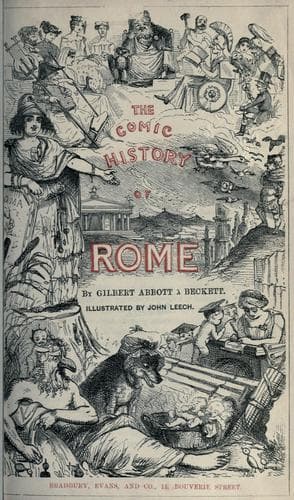
The Comic History of RomeÀ Beckett, Gilbert Abbott
History
The Comic History of Rome
À Beckett, Gilbert Abbott
Rome -- History -- Humor; Wit and humor, Pictorial
The Samnites and the Romans were now perfectly agreed in their
determination to fall out, wherever they might happen to fall in with
one another. A series of small conflicts ensued, of which the accounts
are almost as conflicting as the battles themselves; but there is every
reason to believe that Fortune showered her favours right and left, by
giving them first to one side and then to the other. L. Papirius Cursor,
the Roman Consul, seems to have made himself the pre-cursor of his
country's ultimate success, for he is said to have led the way to it by
recovering Luceria. Hostilities had by this time become so fierce, that
it was necessary to take a little breathing time on both sides, and a
truce of two years was agreed upon. The war was then renewed under L.
Æmilius and Q. Fabius, the dictators, who fought with various results,
taking occasionally a city, and at other times being compelled to take
what they were not at all disposed to receive at the hands of an enemy.
No very remarkable incident occurred at the recommencement of the war,
excepting the taking of the town of Sora by treachery; but meanness and
deception were so common in the time we write of, that any event
involving those despicable qualities cannot be considered unusual. Sora
was situated on a rocky eminence, and though secure to a certain extent
in its lofty position, it was not above the reach of that low cunning
which will stoop to anything for the attainment of its object. A
deserter, who appears to have had everything his own way among the
Samnites, as well as among the Romans, persuaded the latter to retire
some miles off, as if they had abandoned the siege, and then ordered
them to have a regiment of cavalry concealed in a wood near the city.
What the Samnites were about during these proceedings does not appear;
nor is it easy to understand how they could have overlooked an important
branch of the forces of the enemy among the trees; but tradition, when
she wishes to shut her eyes to a difficulty, never hesitates to shut the
eyes of all whose vigilance might have been fatal to the incident about
to be related. The inhabitants of Sora may therefore be supposed to have
been fast asleep and slow to wake, or to have had their backs turned, or
to have taken something which had turned their heads, when the deserter
was making his arrangements for the betrayal of their city. Having taken
the steps already described, he conducted ten Roman soldiers up a sort
of back staircase behind the crags; and the blindness of the inhabitants
of Sora had come to such a pass, that the mountain pass was so
thoroughly lost sight of as to be left without a single sentinel. Having
lodged the ten men in the fortress, he concealed them there until night;
but it is difficult to say how the ten stalwart soldiers could have been
so thoroughly put away in the day-time as not to be observed, unless
tradition, wishing to put her own construction on the affair, has
Public-domain text, read in full here on John Shaqi.
Reviews
Reviews
No reviews yet
Be the first to share your thoughts on this work.
Elsewhere in the archive
Join the Discussion
Join the discussion
Sign in to leave a comment or review.
Sign InorCreate an account