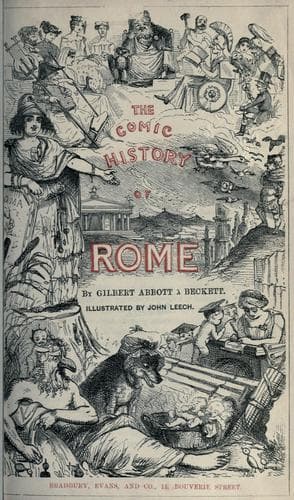
The Comic History of RomeÀ Beckett, Gilbert Abbott
History
The Comic History of Rome
À Beckett, Gilbert Abbott
Rome -- History -- Humor; Wit and humor, Pictorial
proceeded to the construction of some secret cupboard in the fortress,
where the men may have been closeted together until the hour arrived for
their being brought into action. Waiting till the dead of night, the
deserter desired the ten men to shout as loud as they possibly could,
and to keep on hallooing until the cavalry were out of the wood; a
movement which was to be effected when the deserter, rushing into the
city, had frightened the inhabitants out of it, by running all over the
town in a state of pretended alarm, which was to be accounted for by the
continued shouting of the ten men in the citadel. Notwithstanding the
numerous objections to the veracity of this story, tradition has handed
it down to us, and we, as in duty bound, continue to hand it on, though
we do not allow it to pass through our fingers without taking the
precaution to stamp it with the mark of counterfeit. Tradition proceeds
to say that the scheme was perfectly successful: that the citizens,
frightened by the shouting of the ten soldiers in the citadel, ran into,
or rather on to, the arms of the legions who were advancing with drawn
swords to the gates of the city.
The Samnites having become weary of war, and tired of an existence which
was passed in continually fighting for their lives, determined to bring
matters to an issue as fast as possible. They met the Romans under Q.
Fabius at Lautulæ, where Q was driven into a corner, and ran away, when
his army not receiving from him the cue to fight, rapidly followed his
example. C. Fabius having subsequently come to the assistance of Q.,
they united their forces, and being almost two to one against the
Samnites, they obtained a victory.
Rome had, however, quite enough to contend against in various quarters;
and, among others, the Ausonians betrayed hostile feelings, which were
rendered abortive by another betrayal of a very disgraceful character.
Among the Ausonians there existed a nominal nobility, whose rank gave
them a sort of respectability to which they possessed no moral title.
These nobles, by name and ignobles by nature, were mean enough to admit,
by stealth, into some of the cities of Ausonia, a number of Roman
soldiers in disguise, who, with the cruelty so commonly associated with
fraud, commenced a general slaughter of the inhabitants.
Public-domain text, read in full here on John Shaqi.
Reviews
Reviews
No reviews yet
Be the first to share your thoughts on this work.
Elsewhere in the archive
Join the Discussion
Join the discussion
Sign in to leave a comment or review.
Sign InorCreate an account