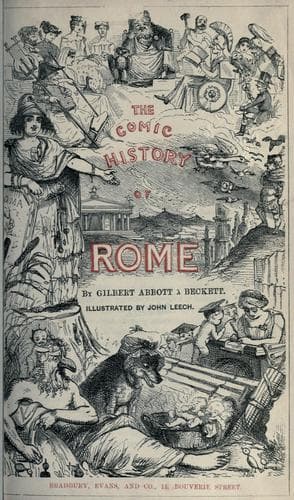
The Comic History of RomeÀ Beckett, Gilbert Abbott
History
The Comic History of Rome
À Beckett, Gilbert Abbott
Rome -- History -- Humor; Wit and humor, Pictorial
It is with sincere satisfaction that we turn from the monotonous details
of war to the arts of peace; and though it is usually said that the
stain of blood can never be wiped out, we are glad to find that the
marks and traces of discord are doubtful and few, while the evidences of
the nobler pursuits of man are numerous and genuine. Among the most
enduring monuments of the art and industry of the Romans, may still be
traced the remains of the celebrated Via Appia, or Appian Way, the
secret for the formation of which would be invaluable to the inhabitants
of our large towns, and particularly to the Paving Boards of the
Metropolis. While parts of the Via Appia remain perfect after upwards of
twenty centuries, the streets of London are torn to pieces year after
year; and it might melt a heart of stone--if stone possessed a heart--to
see the granite continually disturbed by the remorseless pickaxe. The
Via Appia was constructed of large blocks placed very closely together;
and though modern Paving Boards have done their best by laying their
heads together to imitate the plan, success has never rewarded their
labours.
Not less wonderful than the road of Appius, was the aqueduct that bore
his name, and which had solved the question so apparently incapable of
solution in our own times, of the means of securing a supply of water to
a great Metropolis. Though water was not commonly drunk by the Romans as
it is by ourselves, and though the Tiber was purity itself compared with
the Thames, the liquid was so clearly or rather so thickly undrinkable,
that a supply was brought from a distance of eight miles, in the manner
we have mentioned.
While all admit the grandeur of the aqueducts of ancient Rome,
objection has been made to their construction as a needless expense; and
it has been said, that their lofty arches proved only the height to
which folly and extravagance could be carried. Pipes have been suggested
as capable of answering every useful purpose; but considering the
difficulty of obtaining them sufficiently large, of keeping them always
free from obstruction, and other obvious disadvantages, it is doubtful
whether the pipe, after payment of the piper, would prove so economical
in the main. The aqueduct, indeed, has been recently adopted on a large
scale, by a people not likely to retrograde in arts and sciences, though
the rapidity with which they go a-head may cause them to run through the
whole circle of ingenuity, till the most modern invention, arriving at
the same point as the most ancient, affords an illustration of the
meeting of extremes. New York now receives its supply of water through
an aqueduct,[33] carried on solid masonry, over valleys and rivers,
under hills and tunnels, for a distance of forty miles; a proof that
when a city has the will to obtain pure water, there is always a
way--though it may be forty miles in length--for getting what is
required.
Public-domain text, read in full here on John Shaqi.
Reviews
Reviews
No reviews yet
Be the first to share your thoughts on this work.
Elsewhere in the archive
Join the Discussion
Join the discussion
Sign in to leave a comment or review.
Sign InorCreate an account