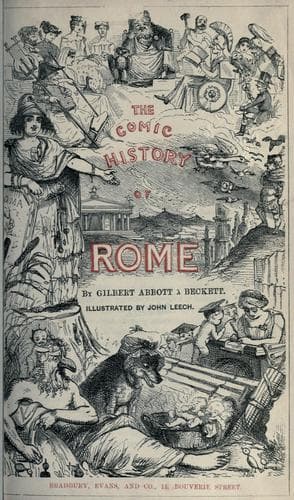
The Comic History of RomeÀ Beckett, Gilbert Abbott
History
The Comic History of Rome
À Beckett, Gilbert Abbott
Rome -- History -- Humor; Wit and humor, Pictorial
In Rome, it had been customary to bore a well where water was wanted,
but the water was so impure, that it soon became necessary to let well
alone. The science of engineering, aided by that great moral engine,
their own energy, enabled the inhabitants to bring their supplies from a
considerable distance, and as the aqueducts were gradually sloped, the
water followed, as it were, its own inclination in coming to Rome.
Filtration was ingeniously provided for, at convenient distances, by
reservoirs having two compartments, into one of which the water fell,
and passing into the other before returning to the main body, there was
time for the deposit of all impurities. Every precaution was taken
against the intrusion of those unhappy families of animalculæ, which are
continually tearing each other to pieces in every drop of the London
element, and whose voracity seems to hold out a faint hope that, as they
are continually demolishing each other, they may be all mutually
swallowed, before the supply of the Metropolis with pure water is
achieved.
During the Censorship of Appius Claudius, the cause of literature, or at
least the dignity of the profession of a public writer, was
advanced--though, perhaps, we ought rather to say, that official
employment was honoured--by the promotion of Cn. Flavius, a scribe, to
the Curule Ædileship. This individual appears to have possessed the
happy gift of investing dry subjects with the garb of popularity; and he
had won considerable reputation by giving the forms of legal actions in
a shape that rendered them comprehensible to the general reader. He made
law legible in his work on _legis actiones_, and had assisted the spread
of information by an almanack or calendar, in which the _dies fasti_ and
_nefasti_ were marked down, and other information afforded which could
only have been obtained previously from the pontiffs.
The lawyers and the priests, who were less liberal in those days than in
our own, were both enraged with an author who had laid open the
mysteries of both professions by a few happy touches of his pen; and on
his being called upon to give the public the benefit of his services as
a curule ædile, they appealed to the miserable prejudice existing
against a man who had shown talent in one line, when called upon to
exert his abilities in some new direction. The nobility were especially
affected at the prospect of the public service being thrown open to
merit alone, instead of gentle or gentile dulness being allowed the sole
use and abuse of official honour and emolument. Exclusiveness and
illiberality could not, even in those days, wholly prevail, though the
opponents of the public writer succeeded in causing him to abandon not
only his literary pursuits, but to give up all his books, and thus
render himself emblematically on a par with themselves in ignorance, by
divesting himself of the types of knowledge on his acceptance of office.
Public-domain text, read in full here on John Shaqi.
Reviews
Reviews
No reviews yet
Be the first to share your thoughts on this work.
Elsewhere in the archive
Join the Discussion
Join the discussion
Sign in to leave a comment or review.
Sign InorCreate an account