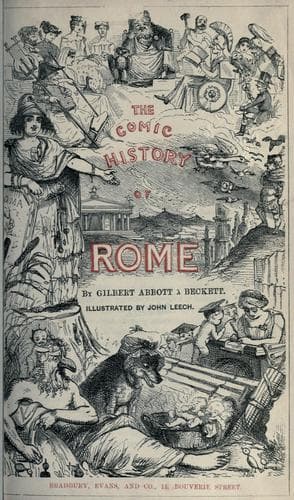
The Comic History of RomeÀ Beckett, Gilbert Abbott
History
The Comic History of Rome
À Beckett, Gilbert Abbott
Rome -- History -- Humor; Wit and humor, Pictorial
The Romans, having lost a considerable number of men, thought it better
to recruit themselves by peace, as they were unable to find recruits for
their army. It was accordingly determined to try the effect of an
embassy upon the Tarentines, and some Feciales were employed to
propose--what Rome considered--very moderate terms of arrangement. L.
Postumius is said to have been one of the envoys, and it is added that
upon his commencing a speech in bad Greek, there was a burst of laughter
at his mistakes in grammar, orthography, and accent. He had been
selected for the charm of his eloquence, but the spell was broken by the
spelling, and in the confusion of his nominatives and datives, he was
unable to make out a case of any kind. The Senators gave way to bursts
of laughter--those bursts of nature which it is often difficult to
control--and a buffoon, encouraged by the bad example of his betters,
played some practical joke upon L. Postumius. The insulted emissary
immediately held up his toga, which had been soiled by the jester, whose
wit seems to have consisted in throwing dirt; but a shout of laughter
was the only reply that the complaint of Postumius elicited. Desiring
them to laugh on, he made an allusion to the possibility of the
operation being transferred to the other side of the Roman mouth, and he
added that a lavatory supplied by their blood was the only wash to which
he would send his toga. Returning to Rome, he pointed out the stain that
had been thrown upon him, and the Senate declared war on the spot the
moment the spot was exhibited. An army was accordingly sent against
Tarentum, but the leader, L. Aemilius Barbula,--so called probably from
his being the little-bearded or the downy one--offered peace a second
time. The Tarentines, thinking the Romans were afraid of fighting,
refused to come to terms; but seeing that the latter did not retire, it
became necessary to seek assistance in meeting them.
It appears that in these early days there were a set of persons willing
to undertake butchery as a trade, by hiring themselves, or rather
lowering themselves, to fight for any one who would pay them. Among
these, one of the most respectable was Pyrrhus, king of Epirus, whom we
may almost regard as a professional spiller of blood, for he took care
to turn his labours to a profitable account, by bleeding those on whose
side he fought, as well as those he fought against. According to some
writers, Pyrrhus was no mercenary, because in agreeing to lend his arms
to the Tarentines, he had in view a kingdom, rather than cash, or, in
other words, he did not propose to be paid by those whom he assisted,
because he intended to appropriate to himself everything out of which
they would have the means of paying him. Pyrrhus, in fact, can only be
excluded from the order of mercenaries by transferring him to the
catalogue of thieves, and of this arrangement we have no objection to
give him the benefit.
Public-domain text, read in full here on John Shaqi.
Reviews
Reviews
No reviews yet
Be the first to share your thoughts on this work.
Elsewhere in the archive
Join the Discussion
Join the discussion
Sign in to leave a comment or review.
Sign InorCreate an account