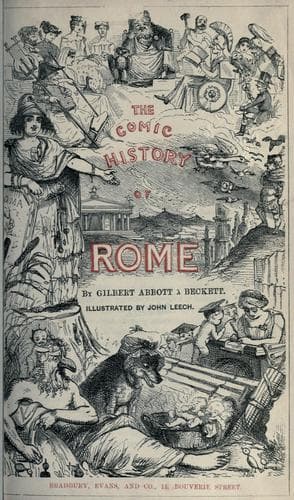
The Comic History of RomeÀ Beckett, Gilbert Abbott
History
The Comic History of Rome
À Beckett, Gilbert Abbott
Rome -- History -- Humor; Wit and humor, Pictorial
While Pyrrhus was thus engaged, or rather disengaged, three
ambassadors, named C. Fabricius, Q. A. Papus, and P. Dolabella, were
sent to him from Rome, to negotiate for the release of prisoners. C.
Fabricius was a very superior man; and Pyrrhus, thinking to gain over
the superior man, employed means by which none but a very inferior
individual was at all likely to be influenced. Bribery was the first
expedient attempted by Pyrrhus; but C. Fabricius showed his contempt for
money by pursing his eyebrows. Having failed in his coarse appeal to
avarice, Pyrrhus tried what was to be done through fear; and one day a
_tête-à-tête_ between the king and the ambassador was disturbed by the
sudden introduction of a third _tête_, in the shape of the head of an
elephant. The sagacious brute stood concealed behind a curtain, and,
with a blow of the trunk on the cheek, he administered a smart box on
the ear to the startled ambassador. The animal accompanied the act with
a hideous roar, and threw his trunk over the head of C. Fabricius, who
remained for a moment unable to see the clumsy joke that was being
played upon him. He, nevertheless, retained his self-possession,
remarking simply that neither by throwing gold dust in his eyes, nor by
the still blacker job of the elephant's trunk, was he to be blinded to
his duty.
Though Pyrrhus would not accede to the terms proposed for ransoming the
Roman prisoners, he allowed them to go to Rome, for the season, to be
present at the celebration of the _fêtes_ of the Saturnalia. These games
appear to have included some rather melancholy mirth, the principal fun
of the affair consisting in the practice of shouting out "Io!"--which is
equivalent to "Go it!"--in the public thoroughfare. Presents were
exchanged among friends; and servants were in the habit of offering wax
candles to their masters,--a sort of composition, perhaps, which the
former came to with their consciences, in memory of the enormities of
the grease pot. The domestic was allowed to wear his employer's clothes;
and this portion of the ceremonies of the Saturnalia is still privately
observed by the gentleman's gentleman of the family. While the wardrobe
of the master remained at the mercy of the valet, the synthesis, or
dressing-gown, was the fashionable attire; and for a period of general
relaxation, this loose wrapper was perfectly appropriate.
Public-domain text, read in full here on John Shaqi.
Reviews
Reviews
No reviews yet
Be the first to share your thoughts on this work.
Elsewhere in the archive
Join the Discussion
Join the discussion
Sign in to leave a comment or review.
Sign InorCreate an account