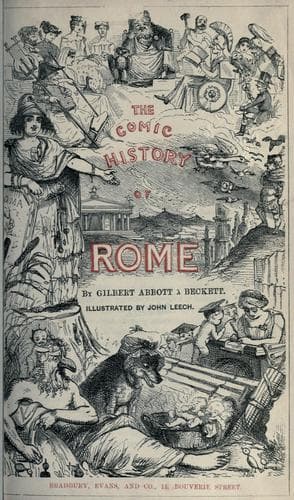
The Comic History of RomeÀ Beckett, Gilbert Abbott
History
The Comic History of Rome
À Beckett, Gilbert Abbott
Rome -- History -- Humor; Wit and humor, Pictorial
The policy of Pyrrhus was to turn old foes into new friends; and he sent
his trusty counsellor, Cineas, to Rome, with a suggestion that all
animosity should be buried in the graves of those who had fallen on both
sides. The Senators were beginning to waver, when Appius Claudius the
Blind--who had been carried down to the house by his four sons--an
arrangement that suggests the picture of a veteran supported by a youth
at each arm and at each leg--declared suddenly that he could see through
the whole affair, and called upon the Romans to open their eyes to the
designs of Pyrrhus. The veteran, who, from infirmity, was unable to stir
without assistance, could still agitate with his tongue; he urged that
the proposals of Cineas should be rejected; and the assembly having
first carried the motion, carried home the mover in triumph.
Cineas, on returning to his master, described the city as a temple, and
the Senate as an assembly of kings; for he could not get the temples out
of his head; and the magnificent curule chairs kept reminding him of the
dignified setting down he had received from the Senators.
Pyrrhus, finding his friendly advances repulsed, resolved on advancing
upon Rome in a less amicable spirit. Proceeding towards Capua, he
encountered Laevinius, the consul, whom he had on a previous occasion
beaten; but he was now not quite so fortunate; for, after a severe
contest, neither side could say exactly which had got the worst of it.
Pyrrhus, however, marched upon Praeneste, which fell into his hands, in
consequence of the Romans having let it slip through their fingers. From
the acropolis of Praeneste he is said to have seen Rome, at a distance
of eighteen miles; but he must have seen very little, if so far off,
unless he was accustomed to magnify what he saw in a very remarkable
manner. The sight was sufficiently imposing to cause him to retreat; and
he went into winter quarters at Tarentum, where he spent his own time,
and the money he had taken from the enemy.
[Illustration: Self-possession of Fabricius, the Ambassador, under
rather Trying Circumstances.]
Public-domain text, read in full here on John Shaqi.
Reviews
Reviews
No reviews yet
Be the first to share your thoughts on this work.
Elsewhere in the archive
Join the Discussion
Join the discussion
Sign in to leave a comment or review.
Sign InorCreate an account