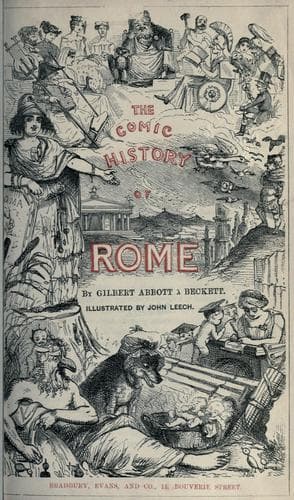
The Comic History of RomeÀ Beckett, Gilbert Abbott
History
The Comic History of Rome
À Beckett, Gilbert Abbott
Rome -- History -- Humor; Wit and humor, Pictorial
As the sword, unfortunately, cuts the most prominent figure in the early
history of Rome, we must not omit to speak of its military organisation,
which was very complete; for in early times there seemed to be an
impression that neighbours ought to be approached with the arm of war,
rather than with the hand of friendship. Every Roman citizen was a
soldier, and was liable at any moment to be called upon to turn his
ploughshare into a sword, though when his special service was over he
was at liberty to turn his sword back again into a ploughshare. This
transformation was not effected without damage to the instrument, and
the ordinary operations of agriculture were frequently interrupted by
calling the labourer from the garden to the field, and forcing him to
drill when engaged in sowing broad-cast. We have in a single chapter of
Livy[39] an account of what a Roman army consisted of during the great
Latin war, and though learned writers[40] have snarled and quarrelled
over the materials, like dogs over a dry and meatless bone, we quietly
walk into the midst of them, and deliberately extract the marrow. An
army may be described in half-a-dozen lines, though it consisted of
five, which were termed respectively, _Hastati_, _Principes_, _Triarii_,
_Rorarii_, and _Accensi_.
The _Hastati_, so called from their carrying the _hasta_ or spear,
consisted of youth in the bloom of early manhood, and who went in front,
that their early bloom might encounter the first blow of the enemy. The
next row was formed of the _Principes_, or men in the vigour of life,
distinguished by the abundance and splendour of their shields, arms, and
accoutrements, and comprising what may be termed the heavy swells of the
army. Next in order came the _Triarii_, a body of veterans, selected for
their past experience--a quality which, however valuable in council, may
be often useless in war; for though experience might have told a veteran
that he ought to run for his life, his heels, being as old as his head,
might have refused to do the latter's bidding. The fourth rank was
composed of _Rorarii_, from the word _Rora_, dew, who sprinkled the
enemy with various missiles, and who standing behind the _Triarii_, must
occasionally, by aiming short of the foe, have given more than their due
to the veterans immediately in front of them. Last in order came the
_Accensi_, or supernumeraries, whose courage and fidelity were not of
the highest class, and who either brought up the rear or left it behind,
as their resolution urged them on, or their want of it kept them back,
while there was always an opening left in case their fears should run
away with them. It was frequently the practice of the _Accensi_ to
reserve the vacant back-ground as a sort of race-course, in which races
between their valour and their discretion were being continually run,
and in the majority of cases the latter got by far the best of it.
Public-domain text, read in full here on John Shaqi.
Reviews
Reviews
No reviews yet
Be the first to share your thoughts on this work.
Elsewhere in the archive
Join the Discussion
Join the discussion
Sign in to leave a comment or review.
Sign InorCreate an account