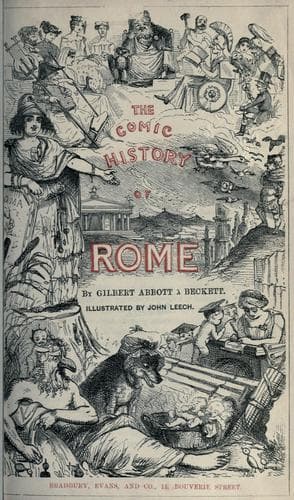
The Comic History of RomeÀ Beckett, Gilbert Abbott
History
The Comic History of Rome
À Beckett, Gilbert Abbott
Rome -- History -- Humor; Wit and humor, Pictorial
The habits of the early Romans were extremely simple; agriculture was
their most honoured employment; and it was thought high praise to say of
any man, that he was a good husband, and a good husbandman. Their food
was chiefly corn; and many a happy family afforded an illustration of
the fact that love, notwithstanding the assertion of the song writer to
the contrary, can sometimes live on flour. Wine was so precious, that,
in libations to the gods, it was poured out drop by drop, to prevent
their getting a drop too much; and, indeed, so scarce was it in the
early days of Rome, that Romulus is said to have used milk in his
sacrifices; while Papirius, at a later period, vowed, in the event of
his victory over the Samnites, a small glass--or _petit verre_--to
Jupiter.
Long beards were worn by the Romans until the arrival of a Greek barber
from Sicily; and he is said to have plucked out, with a pair of
tweezers, the beard which had grown for four centuries and a half into a
rooted habit. On some he employed the razor, and he was able to reap an
abundant harvest from the chins of a people who had never yet worn a
smooth-faced aspect.
The invasion of Pyrrhus caused the adoption at Rome of many Grecian
luxuries, and among others was the luxury of substituting a silver
coinage for copper, which had been found so inconvenient that a rich man
had been obliged to use a wagon instead of a purse, if he wished to take
his money about with him. Silver was, however, so scarce, that one
Cornelius Rufinus was turned out of the Senate for having on his
sideboard more than ten pounds of plate; for it was believed that he
could not have come honestly by so much of it, and he was regarded as
either a thief, or at least as a receiver of stolen property.
So humble were the pretensions to display in those early days, that a
silver cup and a salt-cellar formed, usually, the entire contents of a
Roman noble's plate-basket. Music, among the early Romans, was at the
lowest possible pitch, and the only professors were flute-players, of
scarcely any note, from Etruria. Their strains were so dismal as to be
employed only at a sacrifice or a funeral, when extreme melancholy was
required. On one occasion the band is said to have struck, and retired
to Tibur, when the musicians were only brought back by being made
helplessly drunk,--a weakness to which some of those hirelings who
assist at the performance of funerals are in our day liable.
FOOTNOTES:
[36] Polybius.
[37] Polyb., ii. 20.
[38] The ignorantly squeamish, who may object to the word "togged," will
please to observe that it is purely classical--the Latin _toga_ being
the root of the participle "togged," as well as the substantive
"toggery."
[39] Livy, viii.--8.
[40] Lipsius and others.
CHAPTER THE FIFTEENTH.
THE FIRST PUNIC WAR.
[Illustration]
Public-domain text, read in full here on John Shaqi.
Reviews
Reviews
No reviews yet
Be the first to share your thoughts on this work.
Elsewhere in the archive
Join the Discussion
Join the discussion
Sign in to leave a comment or review.
Sign InorCreate an account