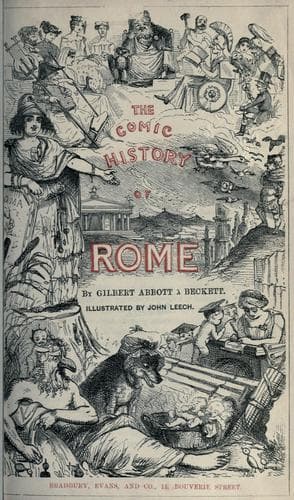
The Comic History of RomeÀ Beckett, Gilbert Abbott
History
The Comic History of Rome
À Beckett, Gilbert Abbott
Rome -- History -- Humor; Wit and humor, Pictorial
After this ludicrous defeat, the command of the Roman navy was taken by
the other Consul, C. Duilius, who determined to wash out in the ocean,
as well as he could, the stain thrown upon his countrymen. He felt that
naval tactics were out of the question among those who were, in one
sense, sailors of the first water, for they had never been on the water
before; and as to rowing, he knew it to be so impracticable that he
resolved to throw the oars overboard. He hit on an expedient for making
a naval engagement resemble as much as possible a fight on shore; and by
overcoming in some respect the inequalities of the waves, he put his own
men on nearly the same footing with the enemy. He constructed boarding
bridges, capable of holding two or three persons abreast, and these
bridges being thrown on to the enemy's ships, enabled the Romans to walk
into them.
The Carthaginians who were not prepared for such close quarters, and had
trusted rather to the roughness of the sea, to deprive their opponents
of an even chance of success, were so thoroughly taken by surprise, that
they suffered their ships to be taken one after the other. C. Duilius
was handsomely rewarded for his victory; he was hailed as the first
naval hero that Rome had introduced, and as if the festive propensities
of a sailor on shore had been foreseen, he was allowed the curious
privilege of being accompanied home at night from banquets by an
attendant with a torch--in which we see a foreshadowing of the policeman
and the bull's-eye. He was further honoured by a _columna rostrata_, a
sort of Nelson Column, adorned with the beaks of ships--a short stumpy
looking affair, of which the museum at Rome contains an imitation from
the hand of Michael Angelo,[42]--who has afforded us a fair copy of one
of the columns of the Times, in which the deeds of great men were
advertised.
This nautical exploit of Rome was followed up by minor successes, and
L. Scipio made an attack upon Corsica, where he was opposed by a
Carthaginian fleet, under the command of Hannibal Gisco, who was killed
by his own men, but honourably entombed by the Romans, who nobly buried
their former animosity.
Carthage and Rome were mutually suffering by their hostilities, and each
nation lost its thousands alternately, according to what is called the
fortune of war; but which, like the fortune of the gaming-table, must
end in the ruin of both sides, for the sole profit of the grim enemy.
While the forces of Rome were being diminished nearly every day, her
enemies were multiplying; and that inextinguishable race, the
Samnites--the increase of whose population would present a most
startling series of returns--appeared to the number of upwards of 4000,
who had been enlisted into the Roman navy. Their intention was to set
the city on fire, but their own leader threw cold water on it before it
was even lighted, by making himself an engine of communication with the
Roman Government.
Public-domain text, read in full here on John Shaqi.
Reviews
Reviews
No reviews yet
Be the first to share your thoughts on this work.
Elsewhere in the archive
Join the Discussion
Join the discussion
Sign in to leave a comment or review.
Sign InorCreate an account