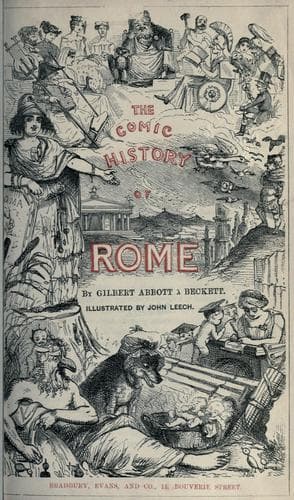
The Comic History of RomeÀ Beckett, Gilbert Abbott
History
The Comic History of Rome
À Beckett, Gilbert Abbott
Rome -- History -- Humor; Wit and humor, Pictorial
Though the Carthaginians had failed on land, their fleet gave them
advantages at sea, for there the Romans were completely out of their
element. The latter, however, resolved to have a navy of their own, and
the Board of Admiralty set to work in good earnest, with the cooperation
of the Woods and Forests, which supplied the requisite timber. The
difficulty now felt, was to obtain a design upon which to build, and
instead of trusting to official surveyors, who might have shown plenty
of cunning, without producing any craft, the Romans took for a model a
Carthaginian quinquereme that had come ashore on the coast of Bruttium.
Being relieved from the supervision of the professional architects, the
ship-building progressed rapidly, and within sixty days after the trees
had been felled, one hundred and thirty ships were built; though the
builders must have been as green as the wood, and as crazy as the craft,
to have imagined that such a fleet could have any but the most fleeting
existence. While the vessels were being got ready, it occurred to the
authorities that crews would be required, and as the Romans had as yet
neither ships nor sailors, a few scaffolds were erected on land, that
the intended tars might try their hands at naval tactics.
[Illustration: Roman Man-of-War, from a scarce Medal.]
Matters went smoothly enough on shore, till the would-be seamen, having
ventured out to sea, found themselves as ignorant as babies, when rocked
in the cradle of the deep; and as the waves washed over them, they
perceived they had learnt nothing of their new art but its driest
details. With seventeen of these queer quinqueremes, each with 300
rowers, who by their misunderstandings kept up a continual but useless
row, the Consul, Cn. Cornelius Scipio, sailed for Messana, when the
Punic Captain Bugud, a regular Carthaginian tar, sent him flying, with
half his timbers shivered, into a port of the Lipari. The crews, most of
them half dead with sea sickness, scrambled as well as they could on
shore. Their commander, Cn. Scipio, was taken prisoner, and so
ridiculous had been the figure he cut, that his countrymen conferred
upon him the name of Asina--or the donkey--a character that might in
these days have qualified him for an appointment to a jackass frigate.
Public-domain text, read in full here on John Shaqi.
Reviews
Reviews
No reviews yet
Be the first to share your thoughts on this work.
Elsewhere in the archive
Join the Discussion
Join the discussion
Sign in to leave a comment or review.
Sign InorCreate an account