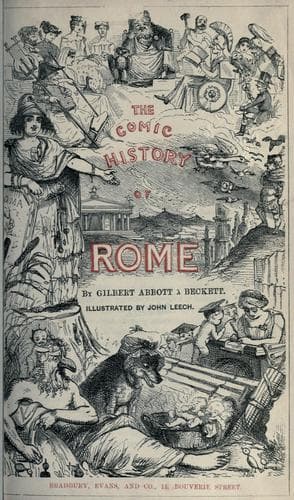
The Comic History of RomeÀ Beckett, Gilbert Abbott
History
The Comic History of Rome
À Beckett, Gilbert Abbott
Rome -- History -- Humor; Wit and humor, Pictorial
The Carthaginians were anxious for peace, and sent ambassadors to the
Roman camp to negotiate, but Regulus, in his proposal of terms, exceeded
all reasonable limits. He pretended to act on the principle of give and
take, but the giving was to be all on one side, and the taking all on
the other. The Carthaginians returned no answer to these insolent
demands; but it is probable their silence must soon have been construed
into consent, had it not been for the valour of a Spartan of the name of
Xanthippus. This individual was a mere mercenary, who put other people
to death for his own living; but he was, at all events, a working man,
and infused his own spirit of energy into the Carthaginian army. He
personally superintended the training, not only of the men, but of the
elephants, and taught the soldiers how to wield as a power those
hitherto unwieldy animals. Taking a hundred under his immediate tuition,
he brought them into such a state of docility, that when turned out for
exercise, they formed a stud worthy of the zoologist's attentive study.
With these sagacious brutes, and a large number of troops, he went forth
against Regulus, whose army amounted to 30,000 men; but the soldiers of
Xanthippus fought with the courage of lions, which, backed up as it was
by the firmness of the elephants, gave them a decisive victory. More
than 30,000 Romans perished, if the accounts handed down to us are to be
believed, and 500 were taken prisoners, though, if the same accounts are
to be believed, the Roman army was only 30,000 strong; so that the 500
captives must have been supplied from some of those exclusive sources
which are open to none but the historian. 2000 more are alleged to have
escaped, but we must leave the reader to solve the difficulty as he can;
for as two into one will not go, so 33,500 out of 30,000 will not come
by any process we are acquainted with. Xanthippus, the mercenary, had
made it worth his while, for he was highly paid, and received rich
presents, with which, as he dreaded the envy of the nobles, he thought
he had better make himself absent as speedily as possible. He returned,
therefore, to Sparta, to astonish the natives of his own city with the
wealth he had acquired.
Public-domain text, read in full here on John Shaqi.
Reviews
Reviews
No reviews yet
Be the first to share your thoughts on this work.
Elsewhere in the archive
Join the Discussion
Join the discussion
Sign in to leave a comment or review.
Sign InorCreate an account