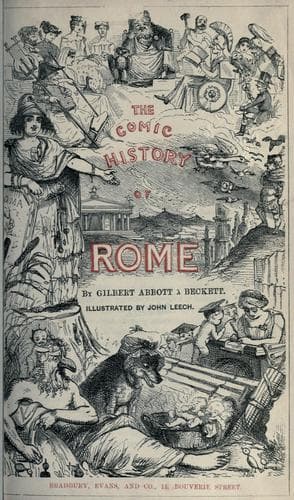
The Comic History of RomeÀ Beckett, Gilbert Abbott
History
The Comic History of Rome
À Beckett, Gilbert Abbott
Rome -- History -- Humor; Wit and humor, Pictorial
The Consuls of the year, Ser. Fulvius and M. Aemilius, were now
despatched with the whole of the Roman fleet, amounting to about 300
ships, to Africa, where, after destroying the whole of the Carthaginian
fleet, it went ashore on the southern coast; and this fleet of 300 ships
lost, according to the authorities,[44] 340 vessels. The Carthaginians,
whose army on land amounted to about 18,000, managed to lose about
30,000 at sea; but an abundant population was still left for the
historian to deal, or rather to cut and shuffle, with. We must confess
ourselves wholly incompetent to grapple with the arithmetical problems
that continually present themselves to us in the course of our
researches, and we therefore postpone all attempt at a solution of the
difficulty until the universal solvent shall be discovered.
The Romans and Carthaginians, instead of being overwhelmed by their own
misfortunes, were in high spirits at the disasters of each other, and
both parties proceeded to repair the damage done to themselves, in order
to qualify them for doing further injury. At Rome the Senate ordered a
new fleet to be built, which took several Carthaginian towns, and
Carthage ordered a fresh army to be levied, which took nearly all the
Roman vessels.
Shortly afterwards another naval force was despatched under the Consuls,
Cn. Serulius Cæpio and C. Sempronius Blaesus, who had got together 260
ships, with which sundry ravages had been committed on the African
coast, when the sea, with its insatiable appetite, swallowed up at a few
gulps the greater part of the squadron.
Rome was now thoroughly sea-sick, and determined to have nothing more to
do with the water, but to wash her hands of it. She was, however, still
powerful by land, and encountered the Carthaginians at Panormus, where
the pro-consul, L. C. Metellus, gained a decisive victory, by turning
the elephants against their owners, and fighting the latter as it were
with their own weapons. This defeat led to a desire on the part of
Carthage for peace, and an embassy was sent to Rome, accompanied by
Regulus, who had been a prisoner five years, and who agreed to consider
himself morally in pawn, pledging himself to return, if the terms
proposed by Carthage should not be acceded to by his countrymen. The
conduct of Regulus seems to have been dictated by a strong love of
histrionic display, for he appears to have been acting a part in which
he sought to make as many effective points as possible. In the first act
we find him at the gates of Rome, refusing to come in, although he had
left Carthage for the purpose of doing so. His wife and two children
having gone to meet him, he looked at them as strangers; but this piece
of dramatic effect may be accounted for as springing from various other
motives than those affecting the patriot.
Public-domain text, read in full here on John Shaqi.
Reviews
Reviews
No reviews yet
Be the first to share your thoughts on this work.
Elsewhere in the archive
Join the Discussion
Join the discussion
Sign in to leave a comment or review.
Sign InorCreate an account