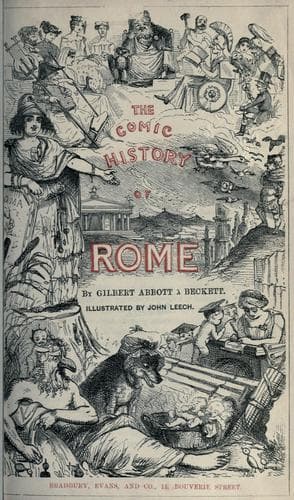
The Comic History of RomeÀ Beckett, Gilbert Abbott
History
The Comic History of Rome
À Beckett, Gilbert Abbott
Rome -- History -- Humor; Wit and humor, Pictorial
The Romans having subdued Sicily, proceeded to prepare a constitution,
or, in other words, having rendered the place subservient to
themselves, they took measures for supplying a livery. Being tired of
the old pattern, they devised something new, and produced an article of
the following fashion:--They made Sicily a province; but those whose
province it is to say what a province was, have left us in some doubt as
to its precise meaning. The best definition is that which derives the
word from Providentia, a duty, or a thing that ought to be done, and the
provinces of the Romans were sometimes done indeed, though in a sense
more modern and familiar than classical. A province, instead of becoming
a part of Rome, retained its national existence, though such existence
was scarcely worth having, for it was accompanied by a loss of
sovereignty,--a condition that may be compared to that of a body living
after its head was off.
A governor was sent annually from Rome with a long train of officials,
and the appointment being only for a year, leaves no doubt that the
holder for the time being made the most he could of it. His staff
included two Quæstors or tax-collectors, and a number of Præcones or
auctioneers, who were always ready to sell off, in the event of a
seizure. Sicily was, in fact, in a state of complete servitude to Rome,
the only anomaly in the relationship consisting in the fact that the
master, or rather the mistress, received the wages, instead of paying
them. The amount was fixed at one-tenth of the wine, the oil, the
olives, and other products of the soil; so that much of the fat of the
land became the perquisite of the mistress of Sicily. These tenths were
called _decimæ_, and so ruinous was their effect on the place whence
they were drawn, that the words decimation and destruction have become
nearly synonymous.
The constitution of Rome had remained much the same during the period to
which the present chapter refers, though the aristocracy of birth was
beginning to give way to the far more objectionable aristocracy of
money. Such was the influence of wealth, that the Quæstors or
tax-collectors became members of the Senate as vacancies occurred, and
the enormous riches of these persons proved how much of the public
money, of which they had the entire handling, stuck to their fingers.
FOOTNOTES:
[41] The word "tyrant" meant, originally, nothing more than a sovereign
who had arrived at supreme power by rather irregular means; but, as
power thus obtained was most commonly abused, the words "tyrant" and
"tyranny" became universally odious.
[42] The curious reader, who is disposed to go over to Rome, will find
the work of art alluded to in the text at the southern extremity of the
vestibule, just at the foot of the staircase leading to the upper
apartments, and close to a marble statue of Augustus.
Public-domain text, read in full here on John Shaqi.
Reviews
Reviews
No reviews yet
Be the first to share your thoughts on this work.
Elsewhere in the archive
Join the Discussion
Join the discussion
Sign in to leave a comment or review.
Sign InorCreate an account