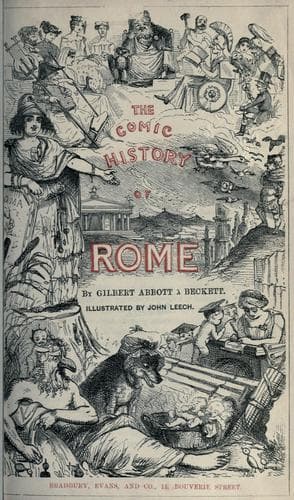
The Comic History of RomeÀ Beckett, Gilbert Abbott
History
The Comic History of Rome
À Beckett, Gilbert Abbott
Rome -- History -- Humor; Wit and humor, Pictorial
The Romans, who were as fickle on the subject of a fleet as the element
to which it was destined, resolved a third time to have a naval force;
but ships were out of the question, when raising the wind was quite
impossible. The state being without funds, appealed to the merchants,
who consented to sink a large sum in an entirely new navy, with the
understanding that if the tide of fortune should turn in their favour,
they were to receive their money back again. The Romans had by this time
become better sailors than before, while the Carthaginian tars had
greatly deteriorated for want of practice. The ships of the latter were
so heavily laden with corn that they could not proceed like chaff before
the wind; and the sailors, encumbered by the cargo, found themselves
going continually against the grain in attempting to work the vessels.
The Romans obtained an easy victory, but it could not have been so easy
to dispose of its results; for, after killing 14,000 men, they found
themselves still saddled with 34,000 prisoners. A peace was concluded;
one of the conditions being, that Carthage should pay to Rome 200
talents by instalments extending over twenty years--an arrangement
equivalent to the discharge of a liability at the rate of one shilling
per annum in the pound, and the extinction of the whole debt by simply
paying the interest.
The first Punic War was now at an end, and it was high time it should
be, for the losses sustained on both sides were enough to have exhausted
the Roman as well as the Carthaginian population; and our history would
then have come to an abrupt termination, like the tragedy of the youth,
who was obliged to drop his curtain in the second act, in consequence of
his having killed all his characters. It is fortunate, therefore, that
the classical authorities, after "cutting to pieces" their thousands and
drowning their hundreds, in a day, should have paused in their career of
devastation just in time to leave something to go on with, to the
conscientious historian.
While, however, war killed everything else, it kept itself alive in the
most extraordinary manner; for though brought to a temporary pause by
having swallowed up all its usual articles of consumption, fresh food
was speedily found, and the jaws of destruction were again on active
service.
Public-domain text, read in full here on John Shaqi.
Reviews
Reviews
No reviews yet
Be the first to share your thoughts on this work.
Elsewhere in the archive
Join the Discussion
Join the discussion
Sign in to leave a comment or review.
Sign InorCreate an account