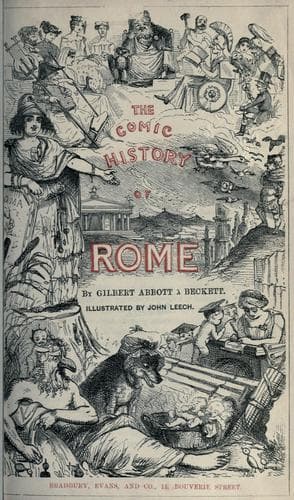
The Comic History of RomeÀ Beckett, Gilbert Abbott
History
The Comic History of Rome
À Beckett, Gilbert Abbott
Rome -- History -- Humor; Wit and humor, Pictorial
Until the Punic War commenced, the state had found money for the public
games at Rome; but war having exhausted the treasury, the expense of
amusing the people was thrown upon the Ædiles, who made the matter a
medium of corruption, for they vied with each other in their outlays, in
order to catch the votes of the people. The Ædile who had carried on the
most extravagant games was the most likely to get elected to higher
dignities; for popularity has ever been, and it is to be feared ever
will be, the prize of those who possess the art of dazzling, rather than
permanently enlightening the people. That their taste was degraded by
those who sought their suffrages, we learn from the fact, that at about
this time the sanguinary conflicts of the gladiators[47] were first
added to the amusements of the populace.
There seems to have existed in almost all ages and countries a morbid
appetite, similar to that which formerly gorged itself on the spectacle
of human beings "butchered to make a Roman holiday." When the
brute-tamer promises to thrust his head into the mouth of the lion, or
the "intrepid aëronaut" is about to risk the dashing to pieces which
some previous aëronauts have experienced, and from which others have
narrowly escaped, the crowds who flock to be present are actuated by the
same sanguinary thirst for brutal excitement which filled the Roman
amphitheatre when an encounter of gladiators was advertised. The
attraction was great enough on ordinary occasions, but an overflow could
always be secured by announcing an entertainment _sine missione_, which
implied that the lives of the conquered were not to be spared. It is to
be feared that many of those who have never been at Rome are
nevertheless prepared to do as Rome did on the occasions alluded to; and
if the certainty, instead of the mere chance, of a sacrifice of human
life were to be announced as an entertainment, the largest place of
amusement in the metropolis would, in all probability, be thronged,
though the ordinary charge for admission should be doubled.
The early Roman gladiators were either captives or malefactors, and were
fed on a particular kind of diet, as brutes in the present day are
fattened for the prize-show and the shambles. To give as much variety as
possible to the sport, the gladiators were divided into different
classes, and, with an excess of ferocity almost incredible, measures
were adopted to give a dash of mirth to the frightful encounters. Some
of the combatants, called Andabatæ, wore helmets without any apertures
for the eyes, so that "roars of laughter" might be excited at an
occasional display of blind fury. Others, called Retiarii, carried nets
to throw over the heads of their antagonists, and when caught in these
nets, their lives hung upon a thread; for, if the net did not break,
their defeat was unavoidable.[48]
Public-domain text, read in full here on John Shaqi.
Reviews
Reviews
No reviews yet
Be the first to share your thoughts on this work.
Elsewhere in the archive
Join the Discussion
Join the discussion
Sign in to leave a comment or review.
Sign InorCreate an account