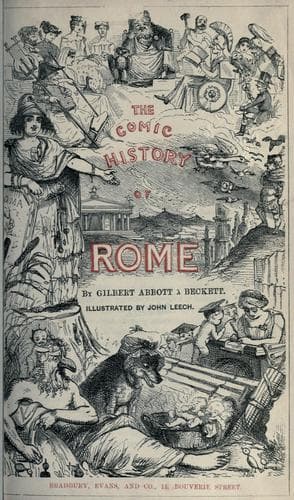
The Comic History of RomeÀ Beckett, Gilbert Abbott
History
The Comic History of Rome
À Beckett, Gilbert Abbott
Rome -- History -- Humor; Wit and humor, Pictorial
"Then I offer you war;" when the Punic Senators, taking up his last
word, raised through the senate-house a shout of "War," which, vibrating
through every pillar, was conveyed by every post, and echo sent back an
immediate answer.
[Illustration: His Excellency Q. Fabius offering Peace or War to the
Carthaginian Senate.]
This was a declaration of that Second Punic War, for which Hannibal
began to prepare when Saguntum, after having held out for eight months,
was starved into submission. Though rich in the precious metals, and
particularly in silver, the Saguntines experienced the bitter truth,
that to be born with a silver spoon in one's mouth, is but an empty
gratification, after all, when the spoon has nothing in it. Hannibal
sacked the city, and converted into baggage all the loose silver he
could find, which he kept in hand for the purpose of glutting the
avarice of his troops, whose valour depended materially on other
people's metal.
The battle of Saguntum was signalised by the introduction of a weapon
called the Falarica, which was in one respect a species of firearm,--for
its point was covered with flaming pitch and tow, that, when pitched
with effect, carried fire into the ranks of an enemy. It was, perhaps,
fortunate, that inventive ingenuity had not gone very far among a people
who seemed only disposed to throw away the little they possessed of it,
in the form of destructive missiles.
FOOTNOTES:
[45] Diod. 5.
[46] Aretæus de Morb. diut. Cur. i.
[47] The first public exhibition of the kind at Rome took place B.C.
244, at the funeral of the father of Marcus and Decius Brutus; but the
Ædiles carried out the idea on what they considered a grand scale, and
immense numbers of gladiators were sacrificed for the "amusement" of the
people.
[48] It may be hinted to the student that the Dying Gladiator in the
Museum at Rome is no gladiator, but a Gaul; and the collar round his
neck, supposed to be a mark of disgrace, is, in fact, the Torques, a
symbol of honour. The sculpture is Greek, and belongs to a period of Art
long previous to the introduction of gladiatorial displays.
CHAPTER THE SEVENTEENTH.
THE SECOND PUNIC WAR.
We have now arrived at the great historical drama of the Second Punic
War, which some authorities have divided into five acts; the principal
part being undertaken by Hannibal, and the scenery being laid in Italy,
Spain, Sicily, and Africa. The first act opens with the passage of
Hannibal over the Alps, which forms one of the most remarkable passages
in the life of that renowned soldier. In the second act we arrive at the
taking of Capua; and in the third, we see Hannibal on the look-out for
reinforcements, which never arrive from his brother Hasdrubal. The
fourth act brings us to Italy, from which the Carthaginian commander
makes a forced exit; and for the last act of all, the scene is changed
to Africa, when the curtain and 20,000 Carthaginians fall together.
Public-domain text, read in full here on John Shaqi.
Reviews
Reviews
No reviews yet
Be the first to share your thoughts on this work.
Elsewhere in the archive
Join the Discussion
Join the discussion
Sign in to leave a comment or review.
Sign InorCreate an account