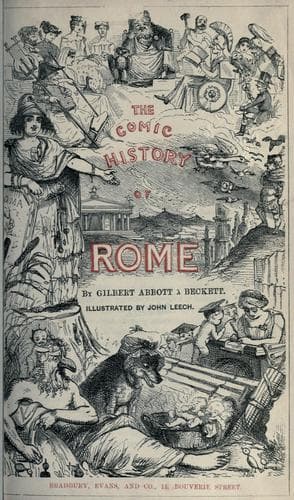
The Comic History of RomeÀ Beckett, Gilbert Abbott
History
The Comic History of Rome
À Beckett, Gilbert Abbott
Rome -- History -- Humor; Wit and humor, Pictorial
Hasdrubal was succeeded by the son of Hamilcar Barca, a young man, named
Hannibal, whose precocity as a lad was exemplified by an awful oath,
which he took at nine years old, under the direction of his father.
Whether it was judicious of a parent to teach his son to swear, is a
question for the moralist; but whether a child of nine could have
understood the nature of an oath, is usually a question for a judge; and
any intelligent reader may safely act as a judge in the matter alluded
to.
The biographers of Hannibal have endeavoured to prove that he was that
precocious nuisance, an infant prodigy, because, at the age of nine, he
expressed a desire to accompany his father to the wars; though there is
scarcely an infant of those tender years who, if asked "whether he would
like to go with his papa," would not answer "yes," as a matter of
course, without having the slightest notion where he might be going to.
Young Hannibal is said to have learned the art of war in the camp, and
to have gone into arms before he could be considered fairly out of them.
Before leaving Carthage, his father administered to him a soldier's
oath, and the boy swore like a trooper that he would be Rome's
implacable enemy.
[Illustration: _Hannibal, whilst even yet a child, swears eternal hatred
to the Romans._]
On succeeding to the command in Spain, he was twenty-six years old--a
proof that promotion had been very rapid in his case; and, although
merit may have had something to do with his rise, there can be little
doubt that he owed much to interest. Adopting the policy of his
predecessor, he attempted to engrave his name in the hearts of the
Spaniards by the agency of the sword; and he may be said to have
literally thrust himself upon them, though they were often bored to
death by his too pointed attentions. All the South of Spain was under
his thumb, with the exception of Saguntum, which had hitherto slipped
through his fingers. He proceeded, therefore, to take it immediately in
hand, when the Saguntines sent for assistance to Rome, whose Senate
resolved unanimously that Hannibal could not attack the place; but when
a copy of the resolution reached him, he had already begun besieging the
city. He sent word to the ambassadors who brought the intelligence out,
that they would display a sad want of intelligence if they ventured to
come too near to him; and, as he had no time to go to them, they had
better retire. Acting upon his suggestion, they repaired to Carthage,
where they demanded that Hannibal should be given up; and there being
some hesitation among the Carthaginian Senate, Q. Fabius, one of the
Roman ambassadors, made a fold in his toga as if he had some mystery
wrapped up in it. "Here," he exclaimed, "is either peace or war,
whichever you prefer;" to which the Senate, in a spirit rather
military than civil, replied, "Whichever you think proper." Fabius,
throwing back his toga, and assuming an imposing attitude, exclaimed,
Public-domain text, read in full here on John Shaqi.
Reviews
Reviews
No reviews yet
Be the first to share your thoughts on this work.
Elsewhere in the archive
Join the Discussion
Join the discussion
Sign in to leave a comment or review.
Sign InorCreate an account