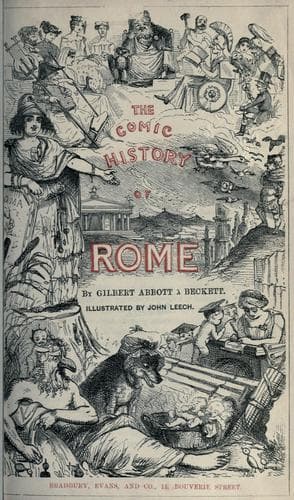
The Comic History of RomeÀ Beckett, Gilbert Abbott
History
The Comic History of Rome
À Beckett, Gilbert Abbott
Rome -- History -- Humor; Wit and humor, Pictorial
The passage of Hannibal over the Alps may be regarded literally as one
of the grandest passages in history. Though subsequent generals have, in
some degree, generalised the achievement, the special merit of it
belongs to the Carthaginian leader, whose superiority over his followers
consists in the fact that they did but find the way, while he might
have claimed the credit of making it. The exploit of Napoleon has been
compared to that of Hannibal, though the former, after all, did but
follow what had been, for two thousand years, a beaten track; the latter
being the individual who beat originally a track for himself, and
thoroughly vanquished every obstacle.
At length, after having nearly lost himself in the Alps, Hannibal found
himself, at the end of a journey of fifteen days, in the plain of Turin.
On mustering his army, he discovered that considerable reductions had
taken place in it; for the foot, which had stood at 50,000 when he
crossed the Rhone, had now dwindled to less than half the number. He had
lost 3000 horse, and his stock of elephants had materially
diminished--the few that remained having become so thin, that there was
a striking falling off in the material as well as the numbers of the
body. So little had his visit been expected, that the Romans were not
prepared for it; and Scipio, who ought to have been waiting at the foot
of the Alps, did not arrive at Pavia until Hannibal had had time to
recruit himself after his late fatigue. Here both armies met, and Scipio
gave battle; but Hannibal's cavalry gave it to him in a sense more
familiar than satisfactory. In the course of the engagement, the Roman
general received a wound, which wound him up to the highest pitch of
rage; and he would have exposed himself to certain death, if his son had
not valiantly rushed between him and the enemy.
The Romans now began to rate each other for having underrated the
strength of the foe; and Tib. Sempronius was recalled from Africa, where
he was wasting his time by wasting the coast in the most unprofitable
manner. Hannibal pitched his camp on the banks of the Trebia, where,
among the bushes, he found for his army a convenient ambush. Sempronius
had by this time joined Scipio, who was still a great invalid, and being
generally indisposed, was not at all disposed for battle. Sempronius, on
the other hand, thinking he should obtain all the glory that was to be
acquired, felt eager for the fight; and Hannibal, from the other side of
the river, assumed the most provoking attitude, in order to tempt the
Romans to come after him.
Public-domain text, read in full here on John Shaqi.
Reviews
Reviews
No reviews yet
Be the first to share your thoughts on this work.
Elsewhere in the archive
Join the Discussion
Join the discussion
Sign in to leave a comment or review.
Sign InorCreate an account